


Every rider has a ceiling on how much oxygen the body can take in and use during hard effort. Training your aerobic base or threshold matters enormously, but eventually the ceiling itself becomes the thing standing between a rider and the top of the power curve. That ceiling is VO₂ max, and it's trained differently than anything below it.
What VO₂ Max Actually Measures
VO₂ max is the maximum rate at which the body can take in and use oxygen during intense effort, shaped by three physiological systems working together:
- Cardiac Output: The amount of blood the heart pumps per minute. Blood carries oxygen from the lungs to the muscles. The more blood you pump, the more oxygen you transport.
- Capillaries: These are tiny blood vessels where oxygen can leave the blood and enter the muscles. More capillaries means more places where oxygen can make the jump. Additionally, muscles can become more efficient at extracting the oxygen out of the blood.
- Mitochondria: These energy factories in the muscle cells will convert oxygen into energy. The more mitochondria you have, the more oxygen you can turn into energy. Additionally, increasing the efficiency of these factories will also increase energy output.
All aerobic training contributes to this metric. Base and threshold work carry most riders a long way. They're the biggest, most durable gains available, and for good reason they come first in almost every training plan. However, those sessions never truly ask your body to max out its oxygen carrying ability. VO₂ Max sessions spend time right at the edge where oxygen delivery can't quite keep up with demand from the muscles. For a well-based aerobic athlete, this is often the least-tapped lever remaining.
Finding the Right Intensity
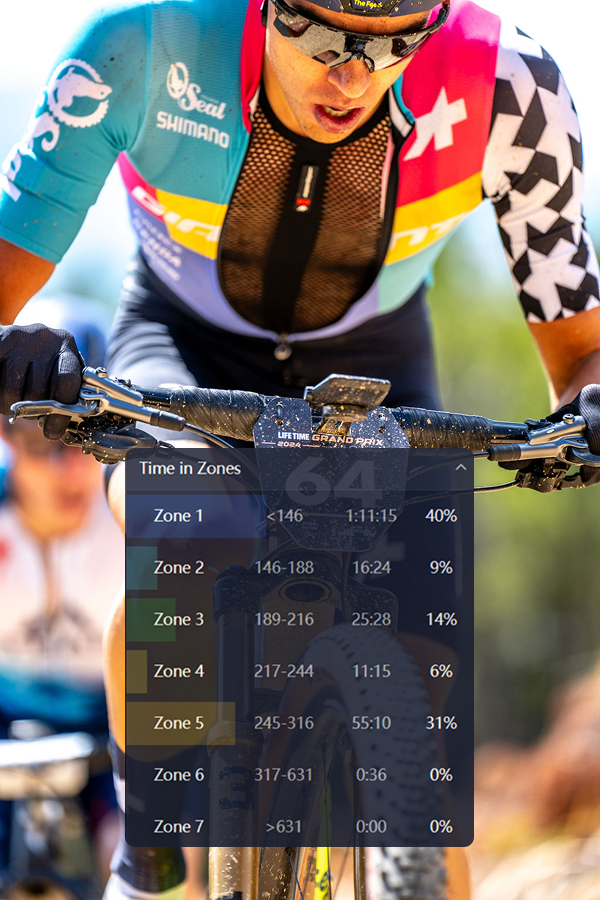
Almost any effort hard enough will push the aerobic system toward its ceiling; if you sprint hard enough, oxygen demand outstrips supply almost immediately. But maxing out the system for a few seconds isn't the same as training it. The goal is to hold it there, sustaining that deficit long enough for the adaptation to take hold. Every second you spend needing more oxygen is more signal to your body to build a higher VO₂ max.
The balance can be delicate. Too hard, and the effort collapses before it does much good. An all-out push over 140% FTP burns through anaerobic energy before oxygen uptake even has a chance to fully ramp up. It's over in a minute or less, which is too little time spent at the intensity that actually drives VO₂ max adaptation. Too easy, and the deficit never gets deep enough to matter. Riding at 100% FTP is sustainable for a long stretch, but it doesn't push oxygen demand high enough to force the desired response.
The ideal VO₂ max intensity is hard enough to create an oxygen deficit, and sustainable enough to hold that deficit for minutes at a time rather than seconds. On COROS's power zone model, this sits in Zone 5 - Anaerobic Endurance, usually at 106-120% FTP. Don't let the "Anaerobic" in the term be misleading. The aerobic system isn't sitting this one out. In fact, it's full-throttle, and needs anaerobic support to meet demand.
Building VO₂ Max Sessions That Actually Work
A useful VO₂ max structure for most riders is 4-6 intervals of 3 minutes in Zone 5, with 3 minutes of easy spinning between each one, once or twice a week. Beginners should start with fewer repetitions and longer recovery, while more experienced riders can add repetitions or trim the rest period to increase total time spent in the zone.
COROS's training library has sessions built and ready to load for every level:
- Beginner: 3 x 2:00 hard, 2:00 easy
- Intermediate: 6 x 4:00 hard, 4:00 easy
- Advanced: 3 x 6:00 hard, 6:00 easy
Each is scaled to a rider's current fitness and ready to send straight to a COROS watch or DURA. Since FTP updates automatically as fitness improves, the Zone 5 target recalibrates itself over a training block, keeping the workout relevant to your ability.

Riding these intervals with a COROS DURA and a power meter takes the guesswork out of pacing them. The device displays live power against the target zone, which prevents the two most common errors: starting too hard on interval one and blowing up, or coasting too conservatively because the effort feels sustainable when it should feel hard.
Perceived effort and breathing pattern are often better real-time guides than the number alone, especially on days affected by heat, poor sleep, or accumulated fatigue from the week's training. A Zone 5 interval should have a rider laboring by the second or third rep, and the rest period should be enough to feel ready to hit the next one just as hard.
Within the workout, try to keep the output as consistent as possible. A session that starts too strong can collapse into Zone 3 by the fourth rep and miss the intended stimulus. Rest is important, too. Too little recovery, and fatigue drags each rep further from the target zone.
Seeing Results
The clearest sign this work is paying off often shows up in moments that never touch a power file: holding a wheel through a race surge, or matching an attack that used to mean getting dropped. But it usually shows up somewhere more measurable too: threshold power creeping upward. Even though sessions are built around a higher intensity than threshold itself, raising the VO₂ max ceiling tends to lift everything training beneath it.
/filters:quality(90)/fit-in/576x432/coros-web-faq/upload/images/f679af9ce2fe282ef6b4edf7d2fce8e6.png)
/filters:quality(90)/fit-in/576x432/coros-web-faq/upload/images/0df9e231b9352e5242d5f4f8c6c26e79.jpeg)
/filters:quality(90)/fit-in/576x432/coros-web-faq/upload/images/376ac5522710418a2cc9ca3d298e827a.jpg)
/filters:quality(90)/fit-in/576x432/coros-web-faq/upload/images/0741607d9f3ff5d65b820eed1b1ff74b.jpeg)
/filters:quality(90)/fit-in/576x432/coros-web-faq/upload/images/2b91a2ad9fb0ca2765a570525e87e1c4.jpg)
/filters:quality(90)/fit-in/576x432/coros-web-faq/upload/images/9100d9507f71cccb83c37c2462f504ca.jpg)
/filters:quality(90)/fit-in/576x432/coros-web-faq/upload/images/c51be8364cef264c442f7eba8d5e542f.jpg)
/filters:quality(90)/fit-in/576x432/coros-web-faq/upload/images/b8425f923e8c6f5a2cee85345718a3e6.jpg)
/filters:quality(90)/fit-in/576x432/coros-web-faq/upload/images/a45bc58c1a9b5a13739e416c27ec2e6a.png)
/filters:quality(90)/fit-in/576x432/coros-web-faq/upload/images/75418f8c0ea8a8b2ba0d356713eb7f5b.jpg)