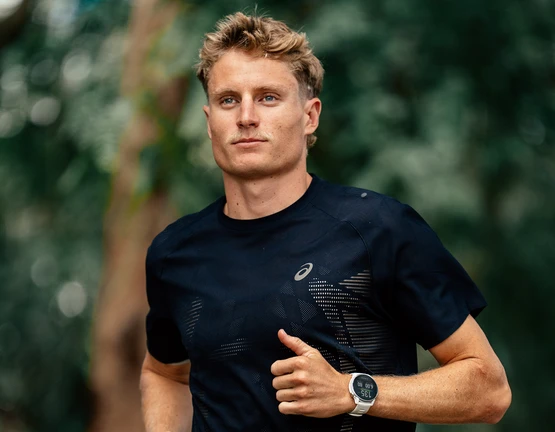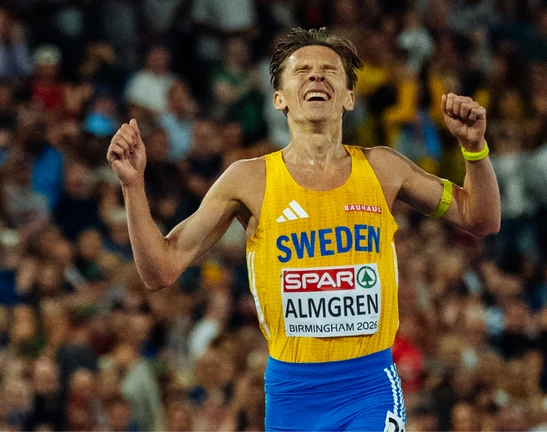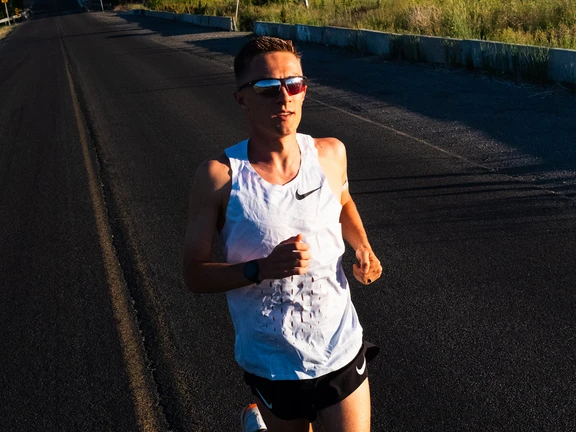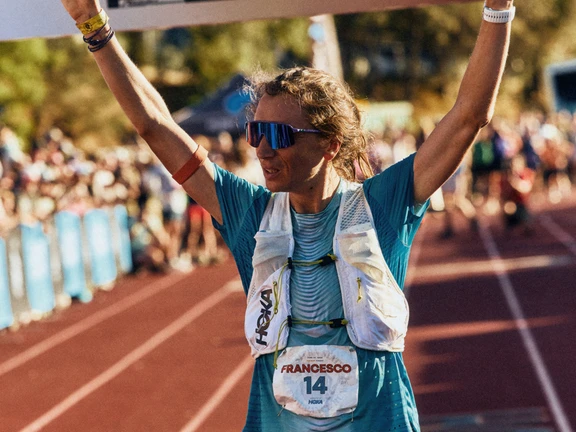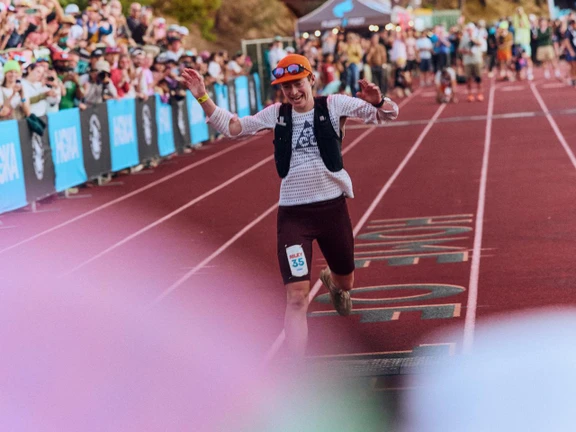


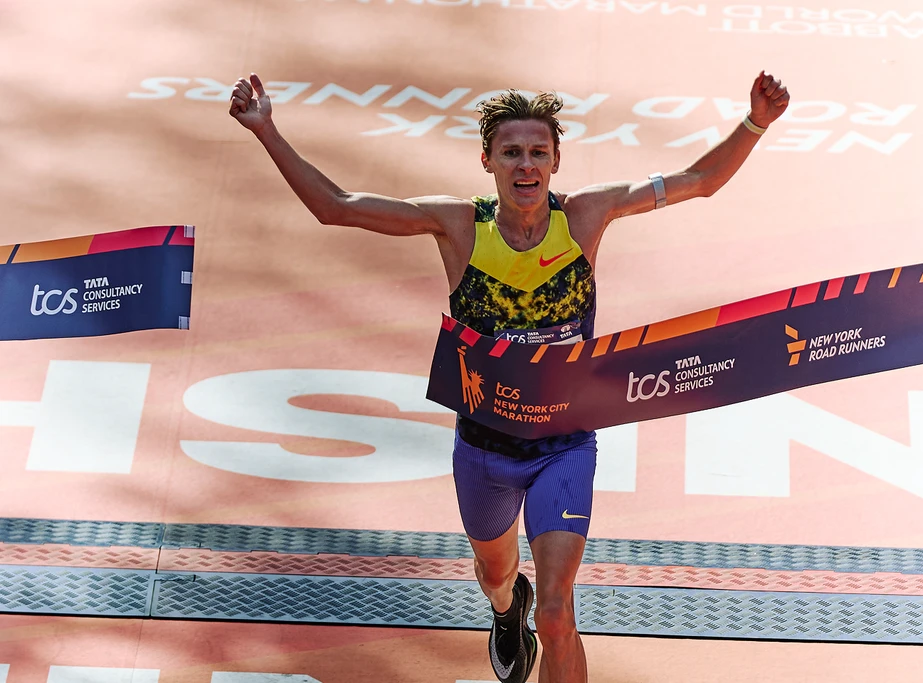
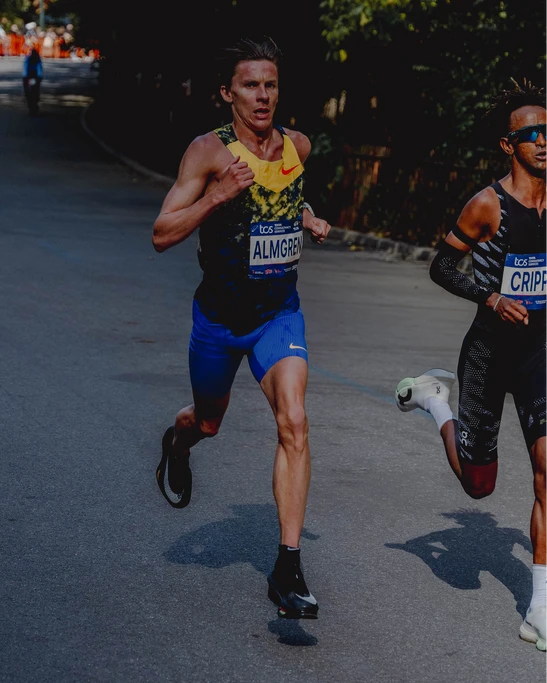
The decisive moment of Andreas Almgren’s New York City Marathon debut win on Sunday arrived against the red-green canopy of Central Park, though anyone watching could be forgiven for not quite grasping what they were about to witness. Head up and eyes forward, he was striding alongside Yemaneberhan Crippa of Italy, whose own gaze was shielded by a pair of blue shades, the hair on both their heads bouncing nearly in rhythm. One of them was going to gut out a win over the deepest field in the race’s history. There was less than a mile to go.
Those two distance icons racing alongside each other would have been a familiar sight to anyone who’d been following what has become a scorching 2026 for Andreas, who now has a major marathon title to go alongside breaking the European 10k road record in January, a European 10,000m crown in August, and the world half marathon title in September. He and Crippa had battled for the European 10k championship, where Andreas wrenched control after the first kilometer and hammered the pace until the thinning lead pack faded to all but one. Andreas was once again about to pull away for a historic win on Sunday, and the moment would have given his fans a bit of déjà vu. The Swede leaned ever so slightly forward, and a gap opened up. Crippa glanced behind him. For a few crucial seconds, Andreas kept his eyes forward.
"With about 5k left I felt like, I’m going to be with this to the end,” Andreas told us, but “I wasn’t sure that I had it until I saw that Crippa was dropping.”
Not long after his victory, Andreas would say that he hadn’t known how he was supposed to feel going into the final kilometers of a distance far longer than any he’s ever raced. No major marathon winner has ever said anything more relatable. Anyone who’s raced 26.2 miles remembers the murky terror of the unknown last 10k, when legs and lungs are sure to screech with revelatory pain. Even Andreas is not immune to that kind of concern, but he also has a bedrock of certainty to fall back on when confronting the unfamiliar: a deep understanding of himself, and trust in his training data.
“Data is obviously something I think is very important for everything,” Andreas – who tracks his own with the COROS PACE series and the COROS Heart Rate Monitor – said after the race. “For me, the combination of feeling, speed, heart rate, and lactate usually plays a big role in how I evaluate everything.”
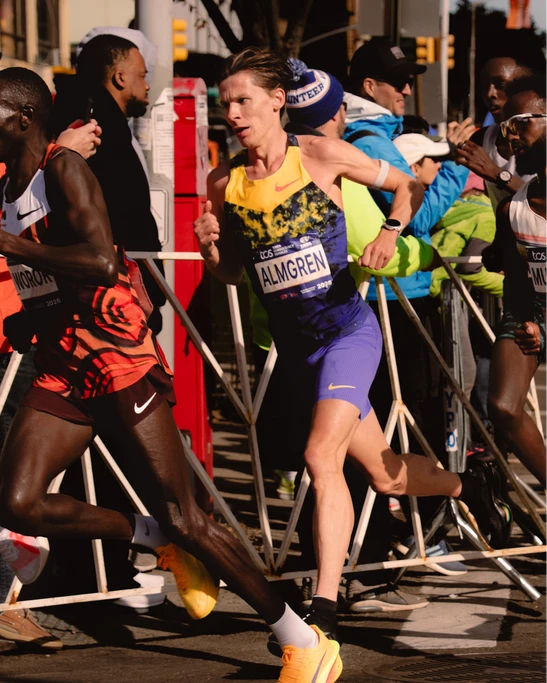
There is perhaps no distance at which experience matters more than a marathon, but there is also no advantage like knowing exactly how far you’ve pushed, and how much you have left to give. Andreas had never been 25 miles into a race, but analyzing his workout data had shown him where he needed to improve if he was going to attack that moment. So yeah, he hadn’t been there before – except that, in a way, he had.
On Sunday, as Andreas headed toward the end of mile 26, no one watching needed a jumble of numbers to tell them that he looked almost comfortable. Still, his data on the day had one last story to tell: somehow, he still had enough in the tank to run even faster.
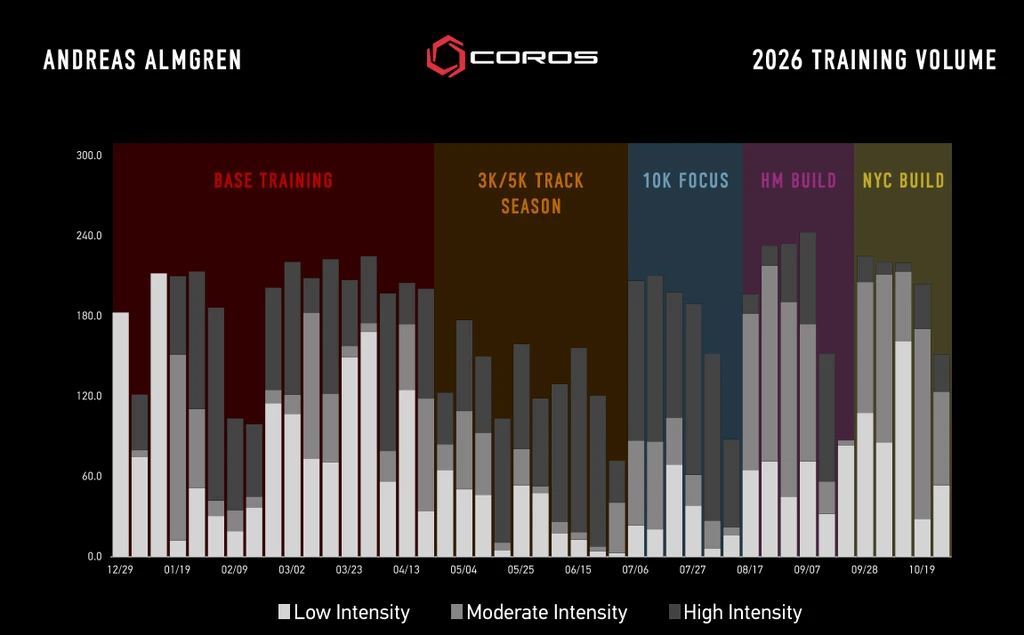
Of course, just getting to that moment takes an enormous body of work – good days that stack end over end until they turn into good weeks, good months, good years. Andreas had to grit through some awful luck before he could build the kind of fitness that would get him onto a podium, a nasty cycle of recurring injuries, fractures, and illnesses. By the start of 2025, he was at last healthy enough to put his legs through week after week of 170km, building a huge base that gave his legs the strength to handle sessions he needed to compete for the sport’s most prestigious titles.
Preparing for a New Challenge
After winning the European 10k championship, Andreas knew he was going to switch to longer runs in Zone 1 and 2 as he ramped up for the half marathon title and then New York. He spent 87% of his 12-week marathon build in lower aerobic zones, but he also pushed into Zone 3 and 4 about 12% of the time. With the remaining 1%, he tapped into his upper anaerobic limits so he could keep in touch with the speed he’s had since he won the 800m crown at the 2014 World Junior Championships.
Andreas has what he calls a “basic philosophy:” Get “as fit as possible,” identify which metabolic system is most likely to limit his performance, and fortify that system with session after session. “I think that mindset is something a lot of people can learn from,” he said. “I think too much data can be a little bit stressful, because you don’t know what everything means, but just find your key data points and monitor them as good as possible.”
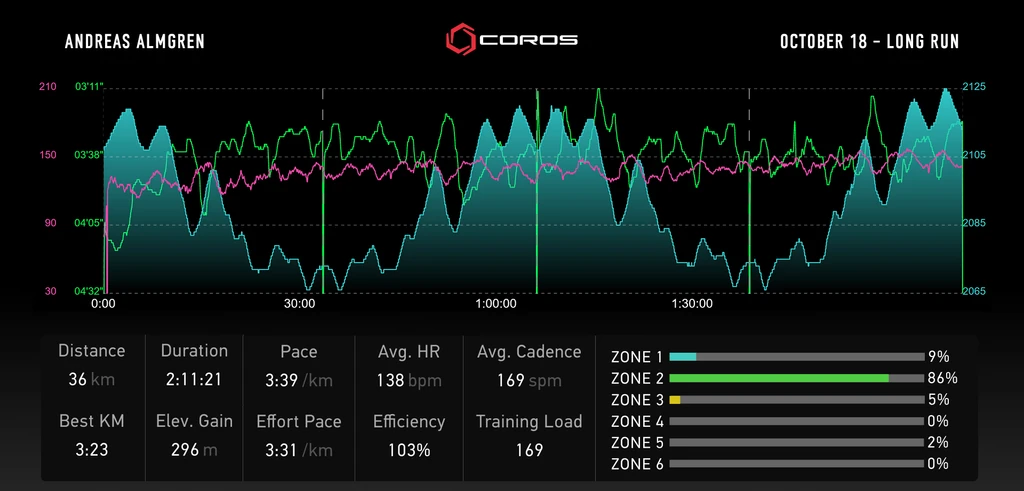
Andreas struggled with sub-anaerobic threshold workouts beyond 15k at the start of the training block, but he got a lot more comfortable at those distances as the weeks started to stack. “I think going for more high mileage, slower runs was a big unlock for me to perform,” he said.
The eventual New York City Marathon champion spent several weeks prior to the race in Flagstaff, finishing off his build at altitude. He logged 36.2 km on Oct. 18, mimicking the course’s uphills and downhills and making sure he never stepped beyond Zone 2. Pace wasn’t so important here – when preparing for a race with uneven terrain, it can’t be. He was focused on maintaining effort. Faster on the downhills, steady on the up.
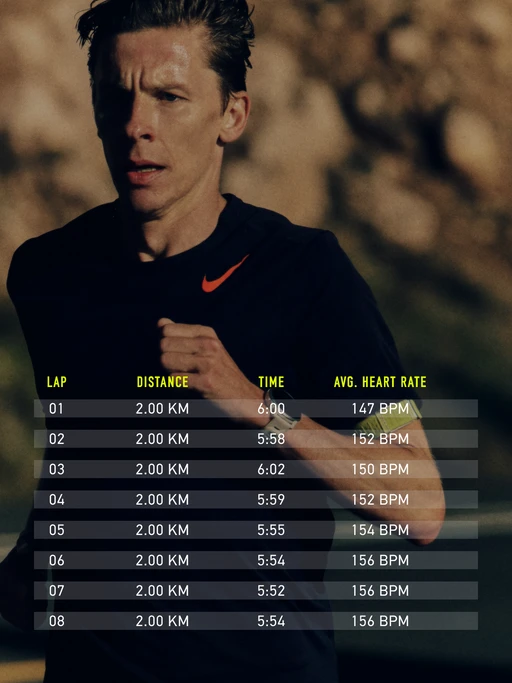
Then there was the big threshold session: 8x2k at marathon effort, targeting about 3:00/km. Andreas wanted to push his body as close to that end-of-marathon agony as possible. When he got to Central Park, he wanted every metabolic system to believe that this was nothing new.
Race Day Execution
The race data tells a story of how numbers can infuse an athlete with supreme confidence and deadly intuition. Andreas cruised through the first 13.1 miles in 1:04:04 (about 3:02/km, or 4:53/mile) while keeping his heart rate at a relatively chill average of 156 bpm, and that laid the groundwork for a much faster second half. His heart rate edged into the low-160s as his pace ramped up, pushing his body into Zone 4, or lactate threshold. Even the most in-form pros can only hang onto this zone for 60-80 minutes, but Andreas wouldn’t need to get anywhere near that outer limit. His form sharpened, his steps per minute climbing from 178 to 183. With less than 5k to go, his heart rate ticked into Zone 5, or VO2max. If Andreas’s training had given his body enough to win, now was the time to show it.
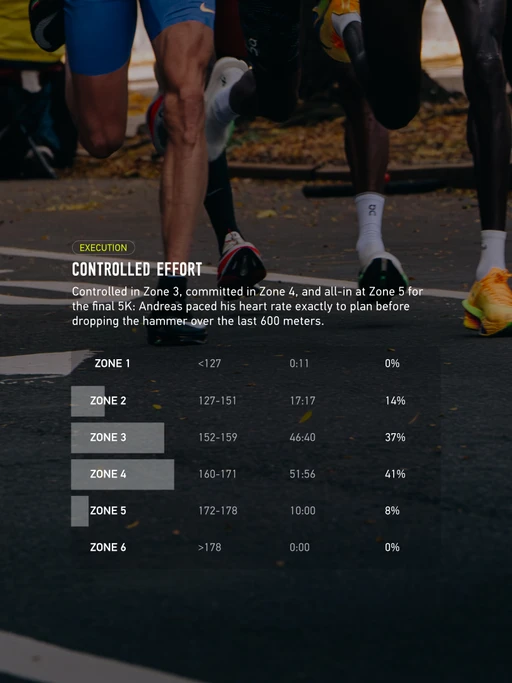
He ripped through the last 600m in 1:34, his legs churning through 195 steps per minute as his heart rate leapt up to 178. Head still up, eyes still forward. By the time the first Swedish man to win a major marathon came roaring down the final curve, he was the only runner in the frame. Andreas broke the tape in 2:06:01, 13 seconds ahead of Crippa, becoming the first European-born man to win since 1996, and the first marathon debutant to come out on top since Ethiopia’s Gebre Gebremariam in 2010. He’d run the back half in 1:01:57, a negative split by over two minutes that came in at 2:56/km (4:43/mile). A year after watching the New York City Marathon from behind the barriers, he had won it.
“I have never been that emotional after a race,” he said. “It first just felt surreal, because I felt that winning was possible, but I didn’t really, truly expect it.” If he had one thing to tell his manager and his friends, many of whom were there at the finish, it would be, “We did it.”