


The Badwater 135 is rightfully dubbed "The World's Toughest Foot Race". Starting in Death Valley in July, it regularly boasts daytime temperatures over 110 degrees. The race then stretches 135 miles from the lowest point in the contiguous US (-282 ft) to halfway up its highest mountain (8,360ft).
COROS Athlete and pro trail runner Max Jolliffe finished the race this year in 20:53:41, the first runner in the race's history to finish under 21 hours, taking roughly 39 minutes off a course record that had stood since 2019 — on his first attempt at the race.
Products Used:
Bringing the Heat
Max's race data shows impeccable execution. His heart rate held in Zones 1 & 2 for most of the race, with a 1-hour stint in Zone 3 up the first climb. He used the CORE Body Temperature Sensor to montor his internal stress, and the COROS POD 2 tracked ambient temperature from his shoe. Starting at 108° in Death Valley, things cooled off a bit overnight, but the afternoon heat peaked at 117° nearly sixteen hours into the race.
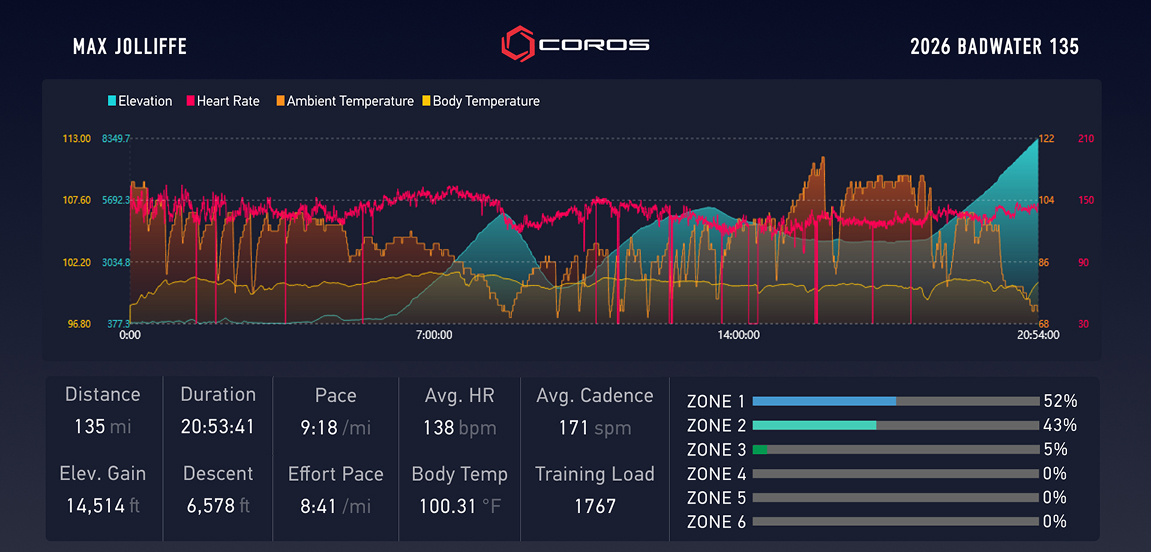
The POD 2 showed numerous sharp dips in temperature. This was a result of Max's cooling strategies. Read on to find out more!
Max never felt like the heat caught up to him. He passed runners on every one of the race's three major climbs, held pace through a long, punishing flat stretch in the afternoon, and picked up his effort in the closing miles to run down both race leader Tamás Bódis and the course record on the final climb to the finish.
"I didn't ever feel like I was getting too warm, or that feeling that I need to throttle it back because I'm getting too hot," Max said. "I never felt that once."
That kind of composure at the hottest race in the world doesn't happen by chance. Years of endurance, weeks of heat training, and hours of logistical prep went into securing the victory.
The Training Plan
Max began training for Badwater shortly after the Cocodona 250, leaving roughly two months to prepare. He was not starting from zero, as Cocodona requires a huge aerobic base and can reach warm temperatures as well. After dropping out of that race, Max was ready to put it behind him and hungry for the next challenge.
"Training the heat and training the vert were the two most important aspects of the training," he said.
The heat side ran 4-5 sessions a week: three active sessions of roughly 50 minutes in a heat suit (treadmill or outdoor afternoon heat) plus one to two passive sessions, sustained across the full two months.
"I think a lot of people do heat training protocols of like 14 days," Max said. "But to me, I felt like there's still more to get out of heat training, so we just hit it hard the entire training block."
The vertical side was just as deliberate: incline treadmill intervals, sessions at TrailCon in Olympic Valley, and time on the actual Badwater course climbs.
"I definitely trained sessions where the heat was quite a bit worse than what I experienced during the race. You train in harsher conditions so that, on race day, whatever conditions you're facing just feel a little bit more tolerable," he said.
Two sessions from that block show exactly how that principle played out.
Simulating Race Conditions
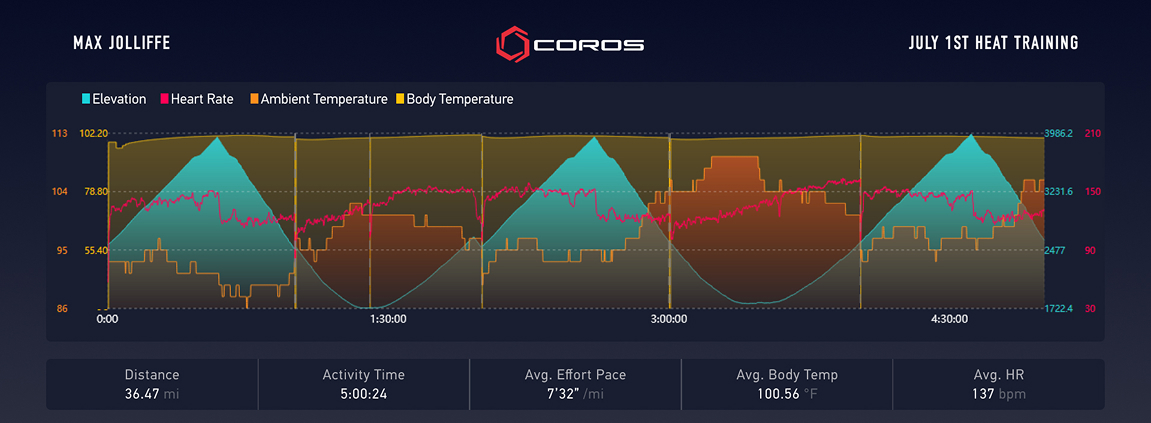
On July 1, Max's session was focused on simulating the race climbs: repeated up-and-down reps on a hot asphalt road. Each climb was roughly 8 miles, with the full session lasting about 5 hours.
The session was also a deliberate test. For the first two hours, Max skipped topical cooling entirely to see how his body would respond.
"For the first two hours of that race, or of this training run, I didn't do any topical cooling just to see how my heat strain would do," he said. "And it did start to climb up."
He began cooling every hour for the rest of the session and held the effort to the finish. Overall, his body temperature was warm enough to spark adaptations, but cool enough to avoid blowing up the session. On similar climbs during the race, his body temperature and heart rate remained lower, showing that his body had adapted from sessions like these.
Playing With Fire
Six days later, on Santiago Peak, his local training mountain, a similar run went sideways. He was focused on a longer effort with plenty of elevation gain (6,788 feet total), but ran into trouble just over 4 hours in.
"Yeah, I kind of got smoked. I just didn't bring enough water. You can see the moment when it got really hot, my heart rate just spiked and I kind of got crushed the last bit of that training run."
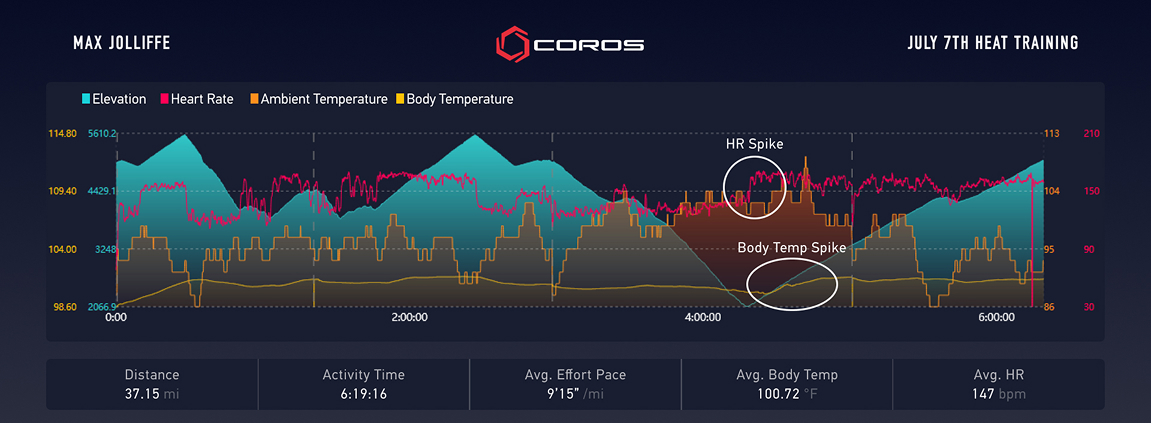
He stopped for aid only once, ran out of fluid, and watched his heart rate climb out of control as the heat and climbing compounded near the end. He struggled his way through the final 2 hours, and took away a valuable lesson to respect the dangers that heat can bring.
"I wasn't very smart and made a mistake that ended up not being that huge of a deal, but it was a reminder that this is serious what I'm doing, and there are consequences if I'm not careful," he said.
That mistake tightened his hydration and cooling logistics for the rest of the block. Running out of water at Badwater was not a risk worth taking.
Staying Cool
With the sessions and lessons behind him, Max knew his body could handle Badwater's heat. Executing on race day came down to a straightforward system: water and ice. Water provides a source beyond sweat for evaporation, and modern fabric technology helps it evaporate even quicker.
Ice, meanwhile, provides a means of cooling via thermal conduction. When over 100°, the air is too hot for that. During the race, Max opted for cooling supplies roughly every 2 miles. His strategy went deep into the science, finding the best places to transfer heat from his body into the ice.
"I started holding my frozen bottles in my hands to dump heat using my palms, which is one of the best places to dump heat," he said.
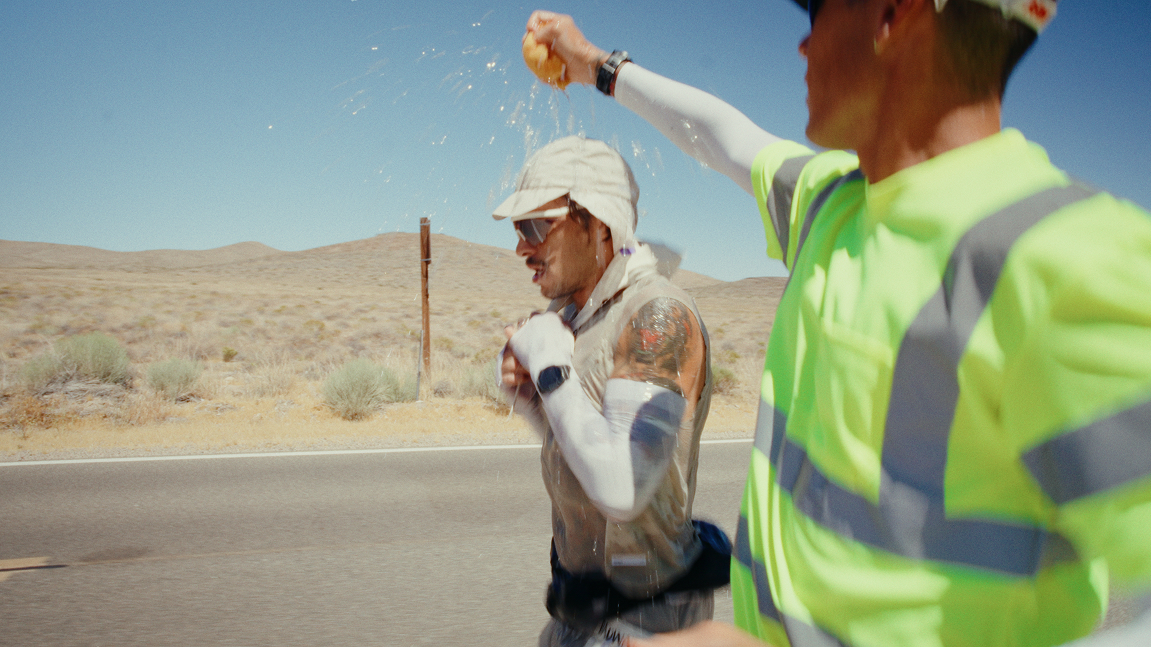
The POD 2 tracked external temperature, but frequently got submerged in water when Max was receiving aid. This uniquely shows Max's crewing moments, along with visualizing how dramatically things cool on the course in the moment.
The strategy ran like clockwork. None of it required him to stop; his crew aided him on the run for the entire race. Not a single step was walked.
The Closer
The hottest Max felt all day had nothing to do with the 135 miles ahead of him.
"Honestly, the hottest that I felt was before the race even started, just getting to the basin and getting out of the car," he said. "It felt like an air fryer."
Everything after the start line was a system already tested, in worse conditions than the ones he actually faced. His internal temperature and heart rate stayed under control, and when the final climb arrived, he was calm, collected, and most importantly, cool. This allowed him to turn on the afterburner in a place where everyone in history has run on an empty tank.
"I pushed so hard and I dug deeper than I probably ever have in any race I've ever done. And it worked out. All the hard training paid off."
/filters:quality(90)/fit-in/576x432/coros-web-faq/upload/images/e58beeda1cd7fc2bef7ac6c49406e3c1.png)
/filters:quality(90)/fit-in/576x432/coros-web-faq/upload/images/10f25ee51776befd8cd8dc63dfa81294.png)
/filters:quality(90)/fit-in/576x432/coros-web-faq/upload/images/0bb00bf0b066be7f17d3a3d3e1beee22.png)
/filters:quality(90)/fit-in/576x432/coros-web-faq/upload/images/c7a93978e5fbaf1b8085bba7b66b0c67.jpg)
/filters:quality(90)/fit-in/576x432/coros-web-faq/upload/images/ba4307fe6d7862b7f598f37beb9434da.png)
/filters:quality(90)/fit-in/576x432/coros-web-faq/upload/images/5d72ae8f18d2bee79a21db3b7ae09dd8.png)
/filters:quality(90)/fit-in/576x432/coros-web-faq/upload/images/e21d23067d06142b227654d2731241bc.png)
/filters:quality(90)/fit-in/576x432/coros-web-faq/upload/images/61181416f2e6c01ba0f349592bbaa8d0.jpeg)
/filters:quality(90)/fit-in/576x432/coros-web-faq/upload/images/6a4cc3b80bf5c15283c21e04417d19cb.jpg)
/filters:quality(90)/fit-in/576x432/coros-web-faq/upload/images/bba6f290954f7800c68037c648f573f7.jpg)