

If you ask professional runner Seth O'Donnell about his sporting background, he'll ask you a question in return. Do you know much about AFL?
He'll tell you about a kid from a public school in Australia, kicking an oval ball on a huge grass field, convinced that outworking everyone around him was the only path forward. He played from age 8 to 18, but when COVID ended the footy season in 2020, the training habit didn't fail. It just found a new sport.
"The most time I'd ever have off is probably a day," he says, with the kind of casual delivery that makes it sound perfectly reasonable. "Having too much fun with it, I guess."
Seth is 24, a licensed physiotherapist, and a distance runner on the ascent. He specialises in the 5,000m and 10,000m, competes with characteristic aggression on the track, and has recently stepped from the domestic circuit onto the world stage, including a run at World Cross Country Championships earlier this year.
"I'd love to compete really, really well on the world stage. Win medals for my country. Run as fast as I possibly can." He pauses. "I don't know how much work needs to go into doing that. So it's just one thing at a time."
That kind of grounded directness runs through everything he does. Seth shares much of his journey on social media. His training tips are fun, and he doesn't flaunt his fitness. Instead, he shares a genuinely relatable story in hopes that visibility might help someone else.
"Genetics aside, there isn't much standing in your way in running," he says. "Especially in the early stages, you aren't limited by how much money you have. A lot of it is what you put in is what you get out. It's a very pure sport in that sense."
He came through the ranks without connections or pedigree, and he knows it. The bigger he gets, the more deliberate he is about using that platform.
The Patient Approach to Data
Most athletes check their metrics daily and react accordingly. Seth does something different. He collects everything... and waits. Oddly enough, this is where his relationship with COROS starts to fall into place.
"We don't use the data to make adjustments on the fly. It's very rare we would do that. We make adjustments on the fly purely based on feel. Where we get the benefit is when we compare it over time."
The payoff comes six weeks later, sometimes more. Run a similar session, hit a similar heart rate or lactate reading, but at a faster pace — that's the signal. Not a gut feeling, not a single data point on a good day, but a pattern that emerges from weeks of consistent collection. In his view, years of building that record will eventually allow him and his coach to predict his fitness state with precision and set race targets grounded in his own physiology rather than general benchmarks.
Support from COROS
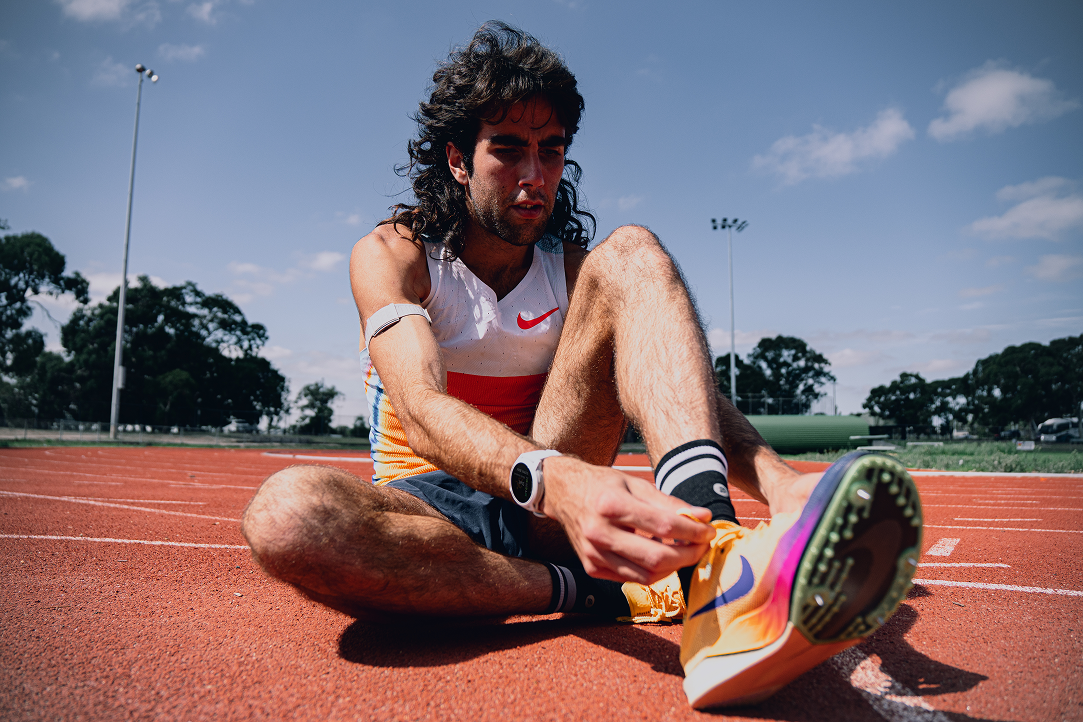
The COROS PACE 4 and Training Hub fit naturally into this approach. Without consistent and accurate data, his approach would fail.
Seth isn't scouring his metrics every morning looking for something to act on. He's building a longitudinal record that gives him and his coach more signal to work with when it actually matters. Heart rate, for example, is used less for zone policing and more for pattern recognition. In threshold sessions they track how quickly it recovers between reps.
"The quicker your heart rate recovers, the more efficient you're working. So the heart rate can be sensitive to those shifts in intensity."
HRV follows the same logic. A sharp drop one day isn't something to act on, but a 30-day average that falls below expectations might be. Otherwise, it sits in the background, quietly added to Seth's growing bank of knowledge.
"You can be really easily influenced by data," he says. "It plays an important role, but we're just trying to keep that stuff as supportive as we can rather than having it make the decisions for us."
It's a deliberately long game. And the patience required to play it is, in its own way, a form of discipline.
The Dimmer Switch
Seth's take on training zones is worth lingering on. It challenges a popular framework, but comes from someone who's thought about physiology professionally, not just athletically.
"I think sometimes 'zone 2' can be misrepresented, as if the heart rates within those zones are key physiological staples and you have to stay within that zone to get that benefit. We know that aerobic adaptation is so much more varied and nuanced."
His analogy: aerobic intensity operates more like a dimmer switch than an on/off switch. The harder you run, the more aerobic adaptation you're accumulating (up to a point). There's no hard line between zone 2 and zone 3, just a gradient of stimulus.
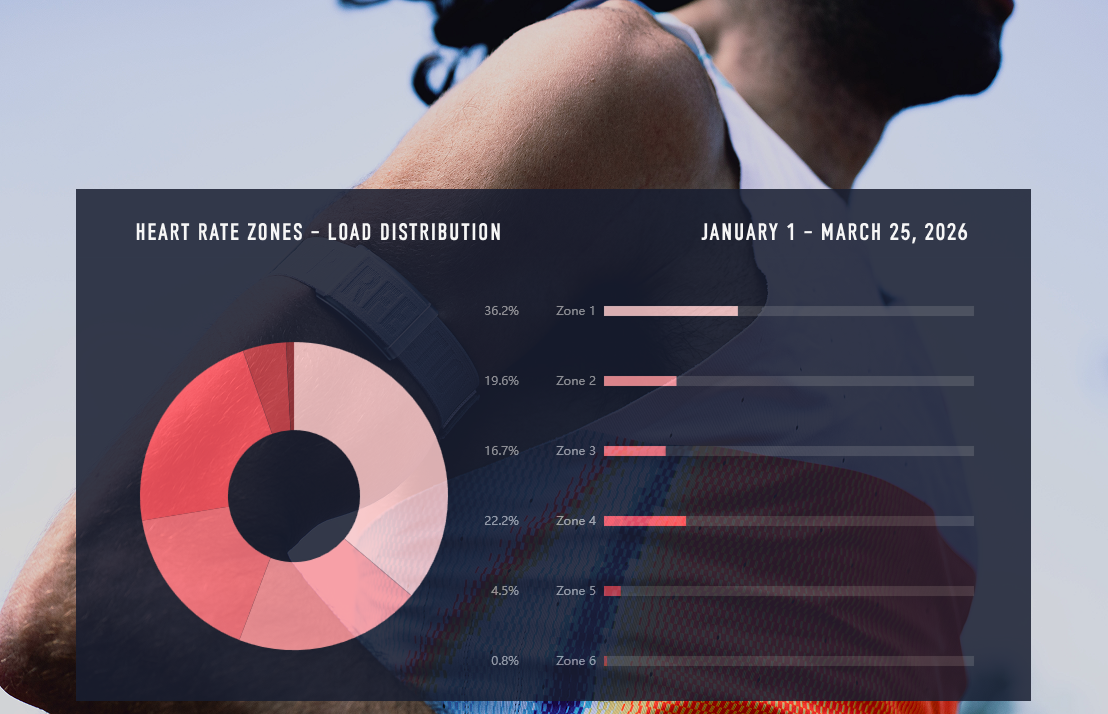
Seth distributes his load more evenly between aerobic zones than most runners
In practice, this means his base-building work includes a genuine variety of aerobic intensities (easy running, traditional broken thresholds, various tempos) all within sessions that don't adhere rigidly to pace brackets. The traditional slow two-hour long run? He hasn't done one in about two years.
"The longer you're out on your feet, the more it takes out of you. And so if you're going to be on your feet for a long period of time, we'd rather be a little bit more specific to the event I'm training for."
Outside the Oval
Seth's passion for the sport is entirely internal. No childhood heroes on the track, no posters on the wall. In fact, he doesn't even follow the sport as a fan. He is driven by the appetite for hard work that grew up in football and found a new home in running.
"I don't get lost in the world of running. I've obviously got a lot of respect for the history, but different in a sense that I've never grown up watching it."
He drums. He supports the Hawthorn Hawks. He works shifts as a physio to keep things afloat. When he spent time in Flagstaff earlier this year, what he missed most wasn't his home training environment. It was having something else to do.
That balance, it turns out, might be one of his most underrated training tools.
What's Next
Seth joins the COROS ANZ athlete roster at a genuinely interesting moment in his career, where the process is well-established but the ceiling is still being tested. Commonwealth Games qualification is the immediate target. What follows depends on how May goes.
His trajectory is part of a wider investment in Australian running development. Last year, Seth was part of the Feet First Programme by SHYU socks — an initiative designed to give emerging athletes the resources, support, and guidance to make the next step. He made that step. This year, COROS ANZ comes on board as wearables partner for the programme, with Olympian and SHYU athlete Cara Feain-Ryan joining as an athlete mentor. The pipeline is building.
For Seth, the ambition is clear even if the timeline isn't.