/filters:quality(90)/fit-in/970x750/coros-web-faq/upload/images/b12625306a9fff9972fdd182afc84840.jpg)
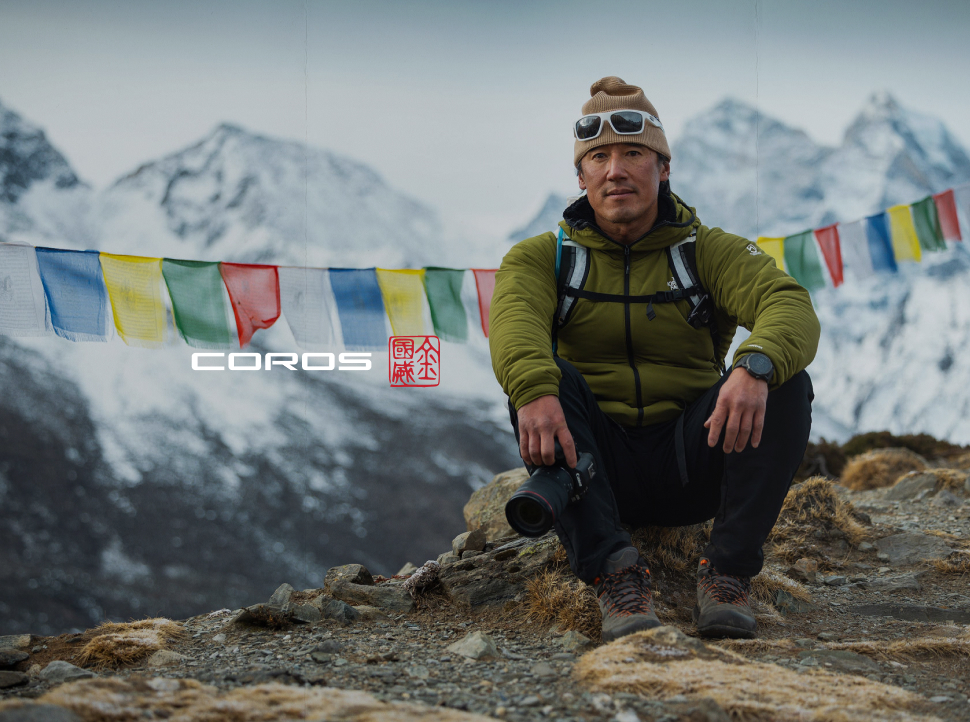
In the world of big-wall climbing, Patagonia is synonymous with grit, weather-whiplashed granite, and some of the most remote and technical rock on Earth. This February, that reputation was written anew when two of modern climbing’s most accomplished big-wall athletes, American legend and COROS athlete Tommy Caldwell and Belgian climber Siebe Vanhee, pulled off a climb many thought was years away: the first one-day free ascent of the South African Route on the Central Tower of Paine.
A Route with History
The Central Tower of Paine, rising over 2,400 meters above Chile’s rugged Torres del Paine National Park, has long been an object of obsession for alpinists. The east face, home to the South African Route, demands more than 30 pitches of steep granite up to 5.12c/7b+.
While teams have freed the route in recent decades, those ascents typically required multi-day pushes under notoriously unstable Patagonian weather. A one-day free ascent seemed, until recently, unrealistic.
“This climb was completely Siebe’s idea,” Caldwell explained. “He had climbed two other big free routes on the wall. He says the idea of doing it in a day seemed absurd at first but like so many big objectives, once the idea sparks, it’s hard to get it out of your head.”
Vanhee first attempted the one-day push years ago but was turned back by bad conditions. That experience planted the seed that it might be possible under the right circumstances with the right partner.
“I think he chose me because I’ve done so many big 24–50 hour pushes,” Caldwell said. “In many ways, my first big climb in Patagonia was similar: a 50-hour push up the east face of Fitz Roy. This is how I’ve almost always climbed in Patagonia. Although it’s not really the standard on walls this big.”
Training for a 24-Hour Limit
Training for a 24-hour free push on a Patagonian big wall requires building durability across all energy systems. For Caldwell, preparation blends high-end climbing power with massive endurance days designed to simulate cumulative fatigue.
“In 2005 I linked up two free routes on El Cap in a single day. At the time that was next level for me,” he said. “After that, I started to understand what it takes to climb at a high level deep into a long effort.”
During his most focused training phases, three days a week were built around stacked sessions: sport climbing outdoors for movement efficiency, followed by gym bouldering and campus board work to maintain top-end power, then weightlifting for structural strength. He would often finish the day with a three- to four-hour bike ride to build aerobic capacity under fatigue.
For Patagonia specifically, Caldwell emphasized that pure difficulty is only part of the equation. Big-wall climbing demands stamina, but also the ability to manage heavy gear, harsh conditions, and long periods of exposure.
“The climbing wasn’t nearly as hard as Yosemite. It was more about negotiating weird conditions, finding the right logistics, having a great partner, and enduring the harsh environment. Those skills are less about training and more about experience.”
Now balancing life beyond climbing, his training volume is more measured, but the philosophy remains the same: combine technical precision, strength, and aerobic depth - then layer experience on top. In big-wall environments, experience often becomes the deciding factor between fitness and success.
The Long Push
When Caldwell and Vanhee left the ground in the early morning hours, the strategy was simple in theory: keep moving. In practice, that meant 24 continuous hours of leading and following every pitch free, through technical granite, deteriorating temperatures, and shifting conditions.
Unlike a steady endurance effort such as running or cycling, the climb demanded constant fluctuation in output. Much of the terrain required controlled, submaximal movement - climbing efficiently, staying relaxed, and conserving energy. But certain pitches forced near-limit efforts, including crux sections roughly 10 hours into the push.
“On really long climbs, I try to stay as relaxed as possible,” Caldwell said. “Keep my heart rate low, use as little energy on each move as possible. If I can keep it chill - focus on deep breathing and regulating my heart rate - I can go for a really long time. That’s critical on climbs like this.”
The terrain itself added complexity. They encountered cold conditions high on the route, requiring gloves and insulation management mid-wall. The upper mountain demanded a full ice climbing kit.
Fatigue accumulated in less obvious ways. Hydration was difficult to manage. Frost nip set into fingers and toes. Toenails were lost. Fingers became swollen and raw from sustained crack climbing. Yet the adrenaline of exposure and commitment masked much of the damage in the moment.
“The danger likely creates an adrenaline response that masks the pain,” Caldwell said. “You end up destroying your body more than you realize.”
They didn’t stop to analyze splits or dive into metrics mid-climb. The focus was movement staying efficient, minimizing wasted energy at belays, and keeping transitions smooth. Every decision was filtered through one question: does this help us keep moving for 24 hours?
When they topped out exactly one day after starting, it was the successful execution of a pacing strategy built on restraint. Hours upon hours of climbing just below the red line, saving enough for the moments that demanded everything.
What the Data Revealed
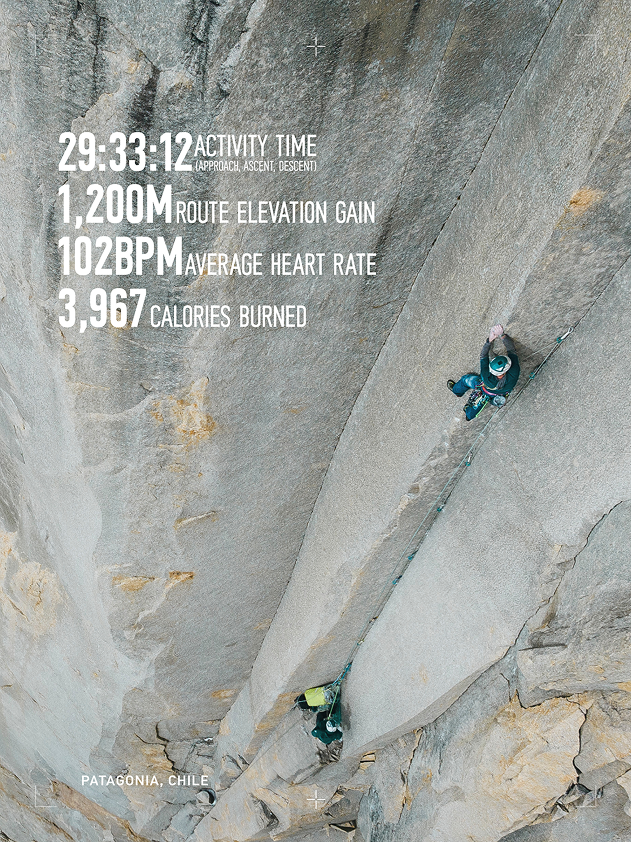
While Caldwell didn’t obsessively monitor metrics mid-climb, the post-climb data told a powerful story.
Heart Rate Was Higher Than Expected
“The metric that most surprised me was heart rate,” Caldwell said. “It’s actually much higher than I would’ve imagined. While climbing, you don’t feel the cardiovascular strain the same way you do biking or running. But the data says it’s there.”
During hard climbing, his heart rate often spiked higher than expected, especially on steep terrain. That awareness changed how he manages his effort.
“It helps me bring awareness to my breath and relaxation. That makes such a big difference.”
The Approach Was a Full Workout on Its Own
“Just getting to the base was 10 miles of distance and 5K elevation gain,” Caldwell said. “That would be a proper workout back home. In Patagonia, that’s just the approach.”
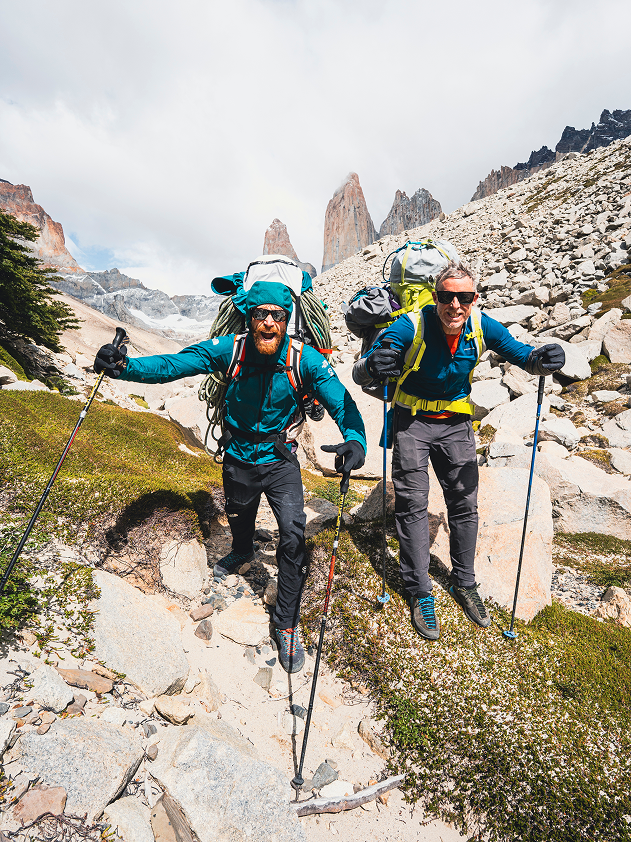
This wasn’t a light-and-fast hike. Because the climb required insulation, an ice kit for the upper mountain, a stove, extra food, and a large rack that included a number six cam, they carried significantly more weight than a typical speed attempt. That load would stay with them on the wall, where they hauled a bag the entire route.
In most places, a 10-mile approach with 5,000 feet of gain would be the day’s objective. Here, it was simply the opening move before the 24-hour free push even began.
Recovery Data Validated the Aftermath
After topping out, Caldwell felt wrecked.
“I felt destroyed after the climb and the data backed that up. My HRV was off. My sleep was weird. I got a bit sick afterward, probably because I’d destroyed myself so thoroughly.”
For him, recovery tracking may be the most valuable metric of all.
“Sometimes when I feel crummy for a week after a climb, I wonder if it’s in my head. But if the stats line up, I understand something physiological is going on and I should give myself more grace.”
In high-risk alpine climbing, that awareness can prevent digging an even deeper recovery hole.
The COROS Factor
For climbers using COROS in technical terrain, Caldwell sees major value in capturing biometrics.
“The biometric data, HRV, stress, sleep tracking, that’s what helps me perform better in all environments. It helps me identify when I’m ready for my next attempt.”
In Patagonia, training intensity swings wildly due to short weather windows.
“My intensity is either way over-exerted or way under. I rarely hit the sweet spot. When I’m home, I try to optimize more.”
Data helps smooth those extremes and supports longevity in a sport where pushing too hard, too often, can quietly erode performance.

Legacy on the Central Tower of Paine
Breaking a multi-day expedition route into a single, continuous 24-hour free push transforms the challenge entirely. It demands technical precision, aerobic durability, psychological resilience, and the ability to manage physiological spikes without imploding hours later.
On the South African Route, Caldwell and Vanhee climbed fast, deliberately, strategically, and with awareness of what was happening inside their bodies as much as on the rock. The result was a new benchmark on one of the most demanding big walls on Earth.