

The Course
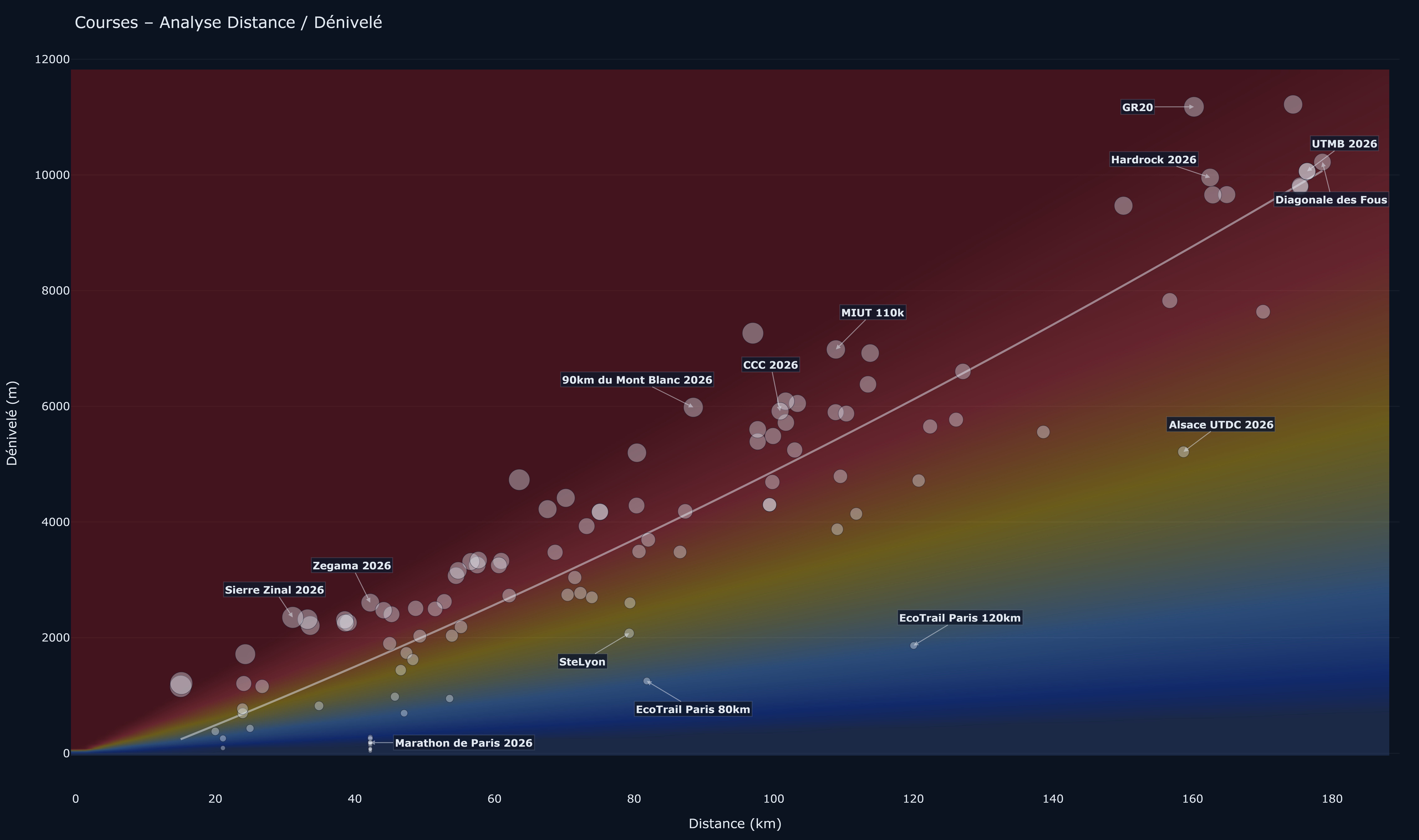
The Ultra-Trail du Mont-Blanc (UTMB) is known as one of the most fearsome races in the world. It is far from being the most technical (such as the Diagonale des Fous), but also far from being the most runnable (such as Western States).
In a few numbers:
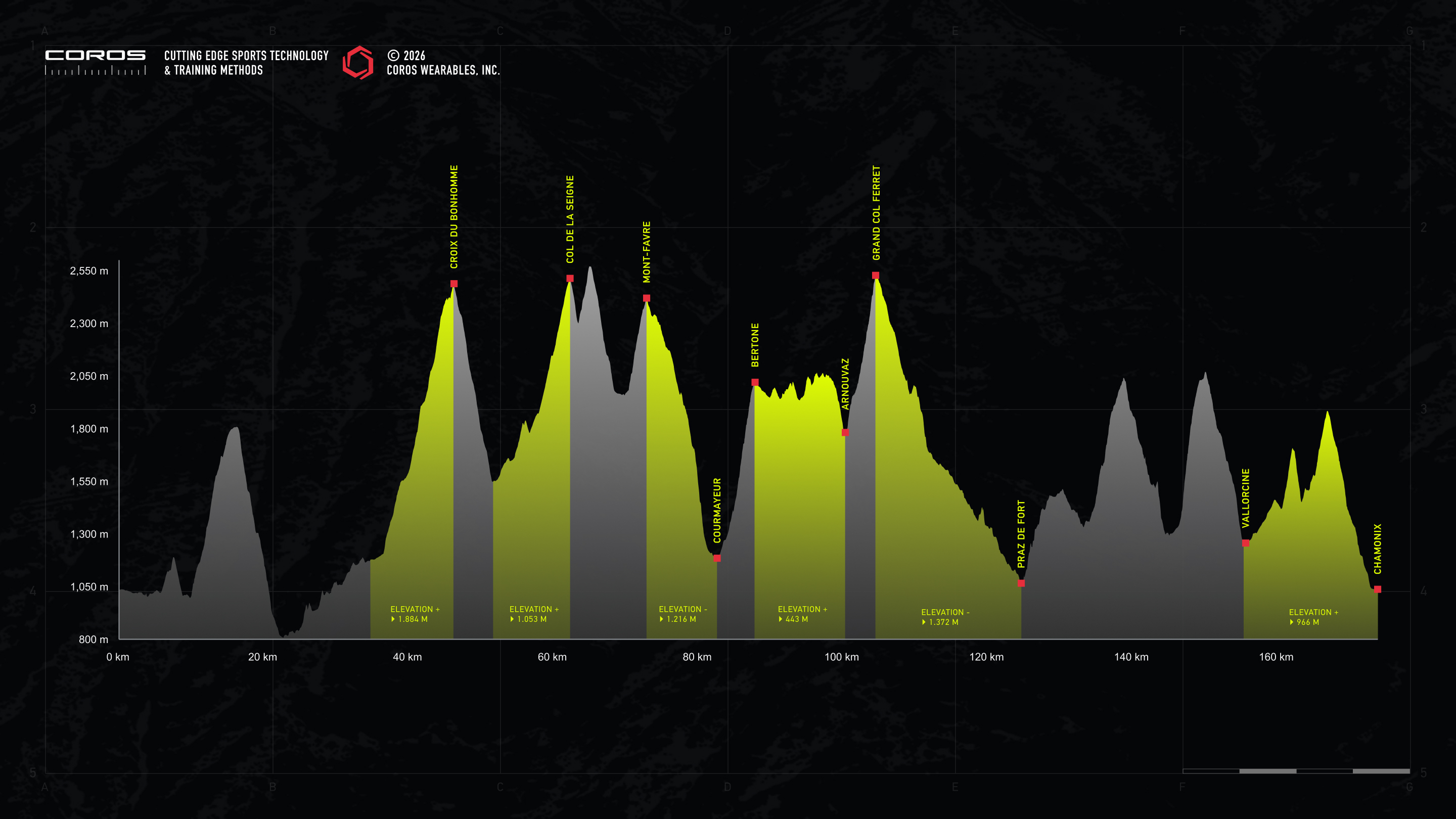
- 177km total distance, 10,000m of positive elevation gain
- 14 aid stations, 4 with crew access (Les Contamines, km 32.5 / Courmayeur, km 83.3 / Champex-Lac, km 130.6 / Vallorcine, km 158.6)
- 4 passes above 2400m altitude
- 37.14km above 2000m
- Multiple climbs at more than 20% grade
Tracing the Route
From Chamonix to Les Contamines, all goes well. The course is fairly runnable over 32.5km.
Climb toward Croix du Bonhomme
Next comes the first difficulty: the climb up to Croix du Bonhomme. For the first time, runners go above 2000m altitude (reaching 2408m). Watch out for the descent to Les Chapieux at night: not very technical, but no less demanding on the legs.
Climb toward Col de la Seigne
Climbing back up toward Col de la Seigne, runners then embark on a stretch of nearly 20km above 2000m altitude. Hypoxia is a very important factor in endurance. If you're not acclimatized, it's essential to keep this in mind and not push your intensity too hard. Don't hesitate to run the first part of this climb, which is fairly runnable and at lower altitude. That won't be possible afterward, as you approach the Pyramides Calcaires with a technical section at 2300m altitude!
Descent to Courmayeur from the Arête du Mont Favre
The descent down to Courmayeur will then leave its mark: 9km with 1170m of negative elevation, including a final section around 20% grade.
Balcony section between Refuge Bertone (km 88.8) and Arnouvaz (km 101.9)
Courmayeur is followed by a climb along the balcony trails between Refuge Bertone and Arnouvaz: a relatively flat section that flirts with 2000m, leading to the Grand Col Ferret — the highest point of the race at 2527m altitude.
The longest descent of the race: from Grand Col Ferret (at 2527m altitude) down to the exit of Praz de Fort (at 1155m altitude)
After that, 20km of descent with 1342m of negative elevation await the athletes: the longest of the race. Then come shorter climbs, but the one at Les Tseppes should absolutely not be underestimated: a particularly difficult 2.1km section that accumulates 620m of elevation gain, i.e. 29.5%!
Final section of the UTMB, between Vallorcine and Chamonix
Between Vallorcine and Chamonix, it's a mental battle, with 3 final challenges:
- The technical descent of Le Béchar, short but intense;
- The climb to La Flégère, exposed and steadily around 17.5%;
- The final descent (from La Flégère), though at this stage, it's hardly a challenge anymore — more the joy of reaching the finish line.
The Weather
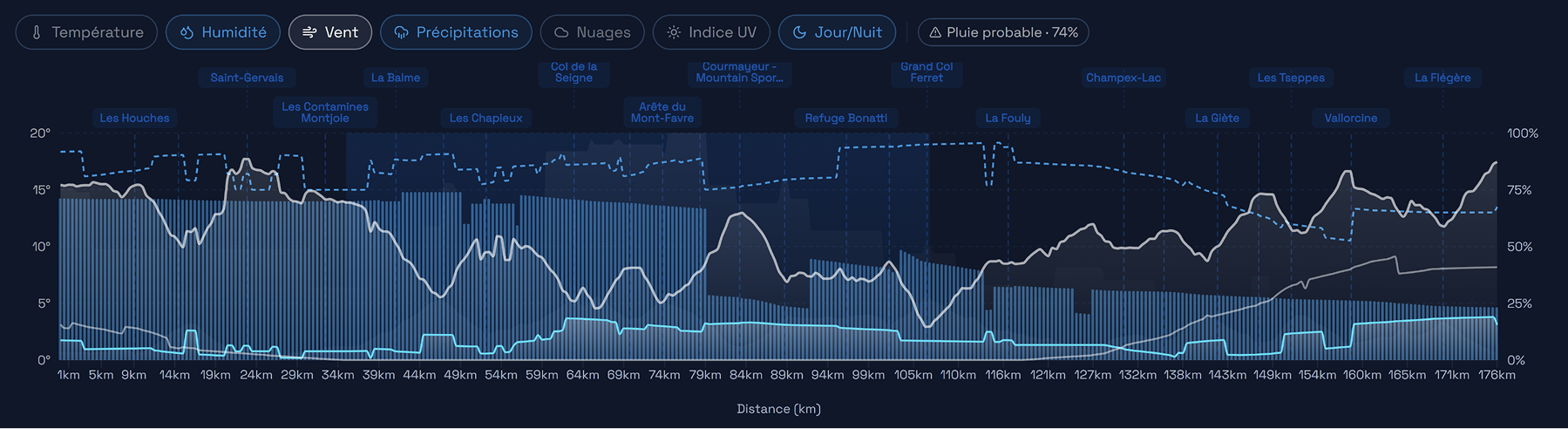
The UTMB course alternates between valley floors and high-altitude, exposed passes, both during the day and at night. Although the race takes place in late August, good weather conditions can never be guaranteed.
At the start in Chamonix, temperatures should be around 15°C. Some clouds may be looming, with a 70% chance of rain, which could make the descent towards Les Chapieux particularly technical.
Temperatures around Col du Bonhomme and the Pyramides Calcaires will be around 5°C, with little to no wind, so conditions should feel comfortable at this stage. However, with the rain, the section around the Pyramides Calcaires will not be easy to manage, so stay focused. The rain should stop around 3 a.m., but remain cautious on the descent from the Arête du Mont-Favre towards Courmayeur.
Grand Col Ferret will be one of the coldest passes of the race, with temperatures around 4°C at approximately 8 a.m. As daylight arrives, however, temperatures will gradually rise. Visibility should remain good all the way to Champex-Lac, where temperatures are expected to reach around 15°C by late morning. At this time, the lowest temperatures at altitude, around La Giète, should be approximately 12°C.
Conditions should remain stable through Sunday, with a pleasant Saturday evening and night into Sunday. Temperatures should remain relatively high, around 14°C on the descent, and around 16°C in Chamonix.
Throughout the race, humidity in the valleys will range from around 90% on Friday night to approximately 60% on Saturday afternoon. Make sure to stay well hydrated and consider using isotonic drinks to help replace electrolytes lost through sweating.
Winds will remain light throughout the race, with maximum gusts of around 20 km/h at the passes.
Clothing Strategy
The goal is to play on modularity, depending on the forecast and what you experience on the ground. A light, breathable waterproof jacket will be your best ally in case of rain, wind, or on exposed passes. A buff and thin gloves can also make a difference in cold sections such as the Pyramides Calcaires or Grand Col Ferret. Arm sleeves make it easy to manage temperature variations between milder valley floors and cooler high-altitude sections (e.g. the descent to Champex-Lac), especially at night.
At each crewed aid station, take the opportunity to adjust: if you're wet, head out with a dry layer. Remove layers on descents into the valleys to avoid overheating, then anticipate the climbs back up to the passes by putting on a breathable layer again if temperatures drop (nightfall, altitude gain) or if fatigue sets in. At UTMB, the right gear is the gear that constantly adapts to conditions and to your own state.
Overall Strategy
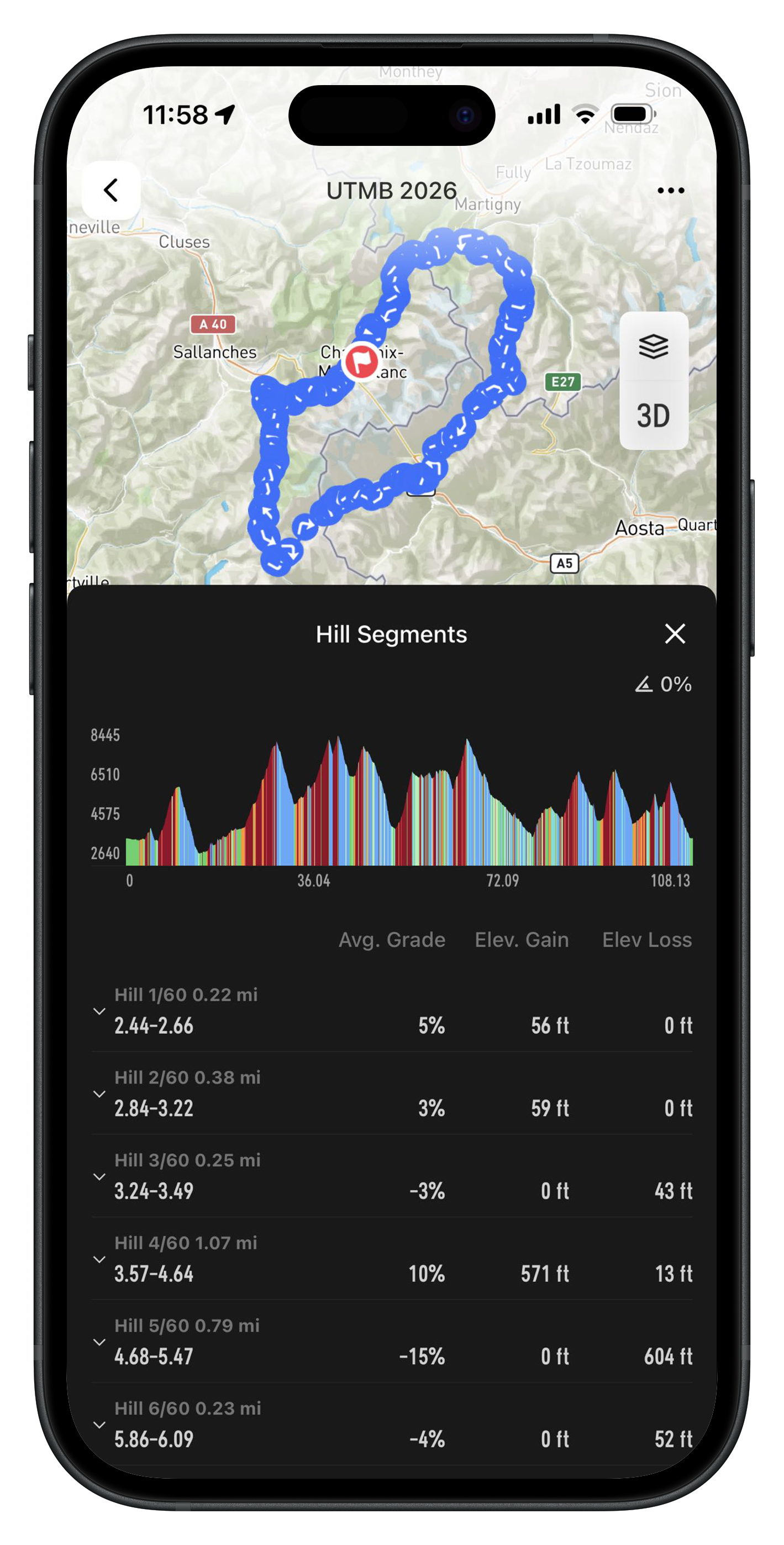
UTMB includes every type of terrain, each with its own strategic value:
- Flats: generally runnable on the UTMB and never very long. This is the ideal moment to open up your stride a bit, enjoy the balcony trails and the flow feeling! Keep an eye on your heart rate early in the race: stay in an extremely comfortable zone, like an active recovery.
- Short climbs: those where you need to be efficient and stay sharp; we're talking 2 to 4km with steep grades. A well-calibrated run-walk alternation lets you pace yourself without blowing up, and above all, keeps some fuel for later.
- Long climbs: where poles become essential. Once again, heart rate must be controlled during the first part of the race. Switch to autopilot mode and use every muscle in your body — legs, but also core and arms!
- Runnable descents: often rhythmic, they leave a lot of muscular damage. Don't try to brake yourself, nor push unreasonably hard. Stay relaxed: you don't make up "time" by destroying your quads.
- Technical descents: rocks, roots, slippery stones… Here, eccentric strain dominates: every footstep costs a lot of energy. Focus on reading the terrain 3m ahead of you. Visualize, anticipate, and don't tense up.
On top of that, manage your transitions well: don't try to pick the pace back up too quickly when moving from a summit into a descent. It's very costly from a mechanical point of view.
As fatigue builds, your heart rate will tend to cap out over the kilometers. And that's not necessarily a bad thing! Your training has made you mechanically durable, and you'll be able to sustain racing intensity. That said, adopting a conservative strategy in the first part of the race will delay this phenomenon: you'll be able to pick the pace back up better and reach higher intensities later.
Night is also an important factor. We observe an increase in heart rate associated with a given intensity in the dark: the body increases its vigilance. Perceived effort can therefore be affected for the same intensity : adjust your effort by easing off 2-3bpm if needed.
Nutrition
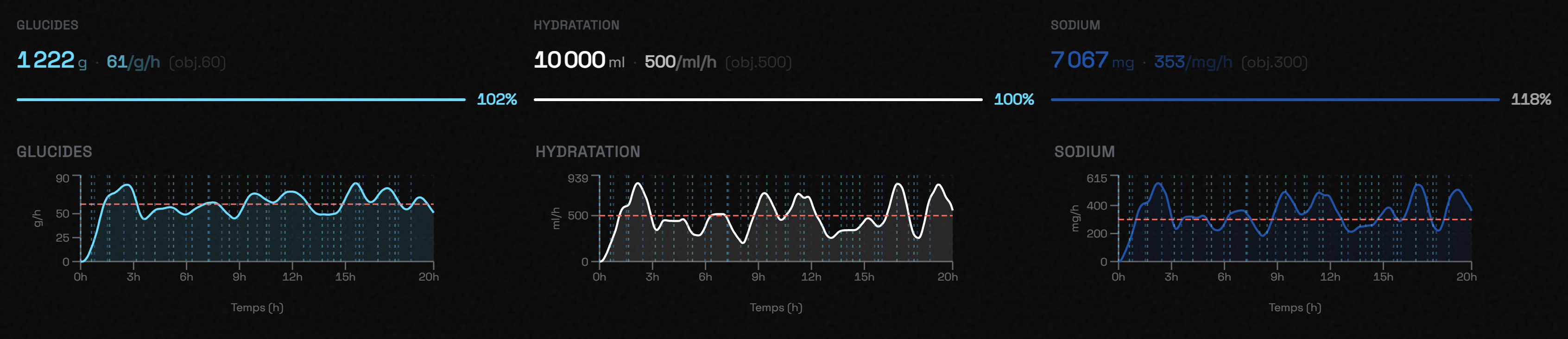
On such a race, nutrition must above all follow your effort. The course alternates between phases of high demand (climbs, technical descents) and moments more suited to digestion (runnable sections, gentle inclines, easy descents).
- On long climbs: intensity increases and digestion becomes trickier. Favor simple, regular intakes: gels, energy drink, small easy-to-consume portions. Don't force it during the toughest sections: stay focused on your effort.
- On runnable sections, gentle inclines, and easy descents: this is a good window for digestion. Effort is more stable, breathing more controlled. It's generally easier to drink, chew, and stick to your nutrition plan. However, don't overcompensate if you've fallen short on your intake.
- On technical descents: avoid eating continuously. Concentration comes first. Instead, anticipate your intakes before these sections, while it's still easy to handle a gel or eat something solid. This way you'll stay sharper while limiting the risks linked to a lack of attention.
- At night: be even stricter about your timing. Reduced alertness and fatigue make it easy to forget to eat. Plan and stick to your intake schedule. Above all, don't rely solely on the feeling of hunger.
The goal is to maintain an overall energy intake suited to the duration of the effort, adjusted to conditions (heat, cold) and to the course profile (climbs, descents). The amounts to consume remain very individual. They depend notably on your digestive tolerance, your effort level, and your nutritional habits. These intakes absolutely must be calculated, trained, and adjusted ahead of the race.
Over such a long race, intake doesn't necessarily need to be the same from one hour to the next. For the same hourly average, it's often worthwhile to consume more on runnable sections or easy climbs, then reduce intake on technical descents or sections requiring strong concentration. A few minutes of anticipation are worth more than a prolonged stop to deal with a bonk.
Finally, keep one simple rule in mind: everything you consume on race day (products, quantities, timing of intakes, and nutrition strategy) must have been tested in training. Race day is not the time to experiment.
Classic Ultra Mistakes to Avoid
Starting too fast
The atmosphere in Chamonix is electric, and it's very easy to follow faster runners. Yet the first 30 to 50 kilometers should feel "too easy." Many pay for an overly ambitious start after Courmayeur.
Underestimating the descents
Climbs tire out the cardiovascular system, but it's often the descents that destroy the quads. Poor technique or insufficient muscular preparation can turn the final passes into a real ordeal. Descents directly impact the climbs that follow.
Mismanaging nutrition
Digestive issues are the leading cause of DNFs in ultra-trail running. You need to eat regularly from the start, without waiting to feel hungry. Stick to the nutrition strategy tested in training (products, frequency, hydration).
Drinking too much… or not enough
Dehydration reduces performance, but excess water intake can also be dangerous if it dilutes sodium levels. The goal is to drink according to conditions and also to replace electrolytes.
Neglecting sleep
For most runners, a significant part of the race takes place at night. Mental fatigue can cause navigation errors, hallucinations, or falls.
Mismanaging your feet
A minor blister at km 40 can become unbearable by km 120. Socks, shoes, lubrication, and foot care at aid stations often make the difference between finishing and dropping out.
Ignoring the weather
On the UTMB, you can go from summer heat in the valleys to near-freezing temperatures with rain or wind on the passes. You need to anticipate changes and not hesitate to adapt your clothing.
Spending too much time at aid stations
Aid stations are comfortable… sometimes too comfortable. Ten minutes easily turns into thirty. The longer you stay still, the harder it is to get going again.
Trying to "make up for lost time"
After a difficult stretch, many runners accelerate abruptly to get back on schedule. This is often the start of a negative spiral. In an ultra, you recover more time through a steady pace than through bursts of speed.
Arriving at the start already fatigued
Overtraining in the final weeks is a classic mistake. The last few days are meant for recovery, not for gaining fitness.
Enduraw Anecdotes
Managing temperature
The altitude range on the UTMB is significant (800 - 2500m). As we've seen, the weather can also vary widely. You'll need to be very reactive to every change.
- Adapt your layers to the temperature and don't underestimate sun exposure, which can quickly raise your core temperature through radiation. On this point, favor light-colored clothing.
- Keep your gear as dry as possible. We're talking about rain, but also sweat. Have sufficiently breathable equipment and change if necessary. In case of dropping temperatures, any dampness could chill you excessively. Note that if you start sweating too much, it means you're too covered up: react quickly.
- Wind and rain can be countered with thin, technical windbreakers and rain jackets. Don't be afraid to bring too many alternatives to your crewed aid stations.
The Role of Crew Support
The UTMB only has 4 aid stations with crew access. If you want to rely solely on your own supplies, you need to be precise about these stops. A forgotten gel is a missing gel. Bringing too much "just in case" means carrying unnecessary weight.
Don't forget that these stations are special moments to connect with your loved ones. Plan the quantities in advance, trust the people supporting you, and live these intense moments together. Disconnect from the race, just for a few seconds.
The Cancellation of Pyramides Calcaires
During the 2025 UTMB, conditions at the Pyramides Calcaires deteriorated significantly during the night. The organizers therefore decided to close this section to runners, shortening the race by 2km and 250m of elevation gain. Ultra-trail running is an extreme discipline that doesn't require taking additional risks. A last-minute change should not affect you in any way: you must accept it and focus on the next point — Lac Combal.
In terms of pacing, just adapt. You work section by section. You get back on track with what was planned for the Lac Combal - Arête du Mont Favre section, and so on. It's not about recalculating all your timings. Doing so will only validate your original goal even more, and if you want to revise it upward, stick to your plan at least until Trient. The race is still long.
Gear Checks
Not announced ahead of the race, they shouldn't surprise you. When packing your bag, plan carefully how you distribute your gear: nutrition, clothing, lights, other mandatory equipment.
Prioritize the essentials, such as bars and gels, so you can access them without wasting time or energy. Group items you're unlikely to use where you can pull them out efficiently if needed (in a closed pouch, for example). Rehearse your retrieval routine: every movement should be smooth, every location in your bag known. Like managing aid stations (crewed or not), this should become second nature!
Also remember to:
- clearly identify your pockets and compartments to avoid any unnecessary searching;
- protect sensitive gear (electronics, spare clothing, nutrition) from weather conditions;
- plan a logical layout: what you use often should be accessible, what you rarely use can be more buried;
- anticipate critical moments (cold, night, fatigue, weather changes) rather than waiting until you need something;
- check your gear before the start and after every time you handle it.
On race day, your pack shouldn't be a disorganized stockpile, but a true personal aid station: organized, mastered, and efficient.
The Enduraw Referees
Your relationship to others, to time, matters. Everyone has a different connection with performance. Some run UTMB with a goal of finishing, others aim for a specific time, others for a ranking. Whatever the case, to get there, you'll need to be the best version of yourself on that day.
During the race, you shouldn't focus on your goal. Still, you should know how to use it as a boost, so you don't get complacent in your performance.
With last year's winners, the Enduraw team mobilized at various points along the course to announce the gaps between the leaders (ahead & behind). For head athletes, these are concrete benchmarks, sources of confidence, and real boosts during their race.
For you: identify what works for you — times, rankings, targets (and yes, that's competition too, a positive form of rivalry!) — and take in this information at the right moments.