


Alex Yee crossed the finish line of the Valencia Marathon in 2:06:38, a time that makes him the second fastest marathoner in British history. As the reigning Olympic triathlon champion, endurance events are his territory. However, choosing a new event as popular as the marathon and catapulting to the top... that takes another level of meticulous preparation.
The result was over 5 minutes faster than his debut marathon in London earlier this year. The data behind Alex's more recent result shows how leveraging data from COROS can improve training, strategy, and overall race readiness.
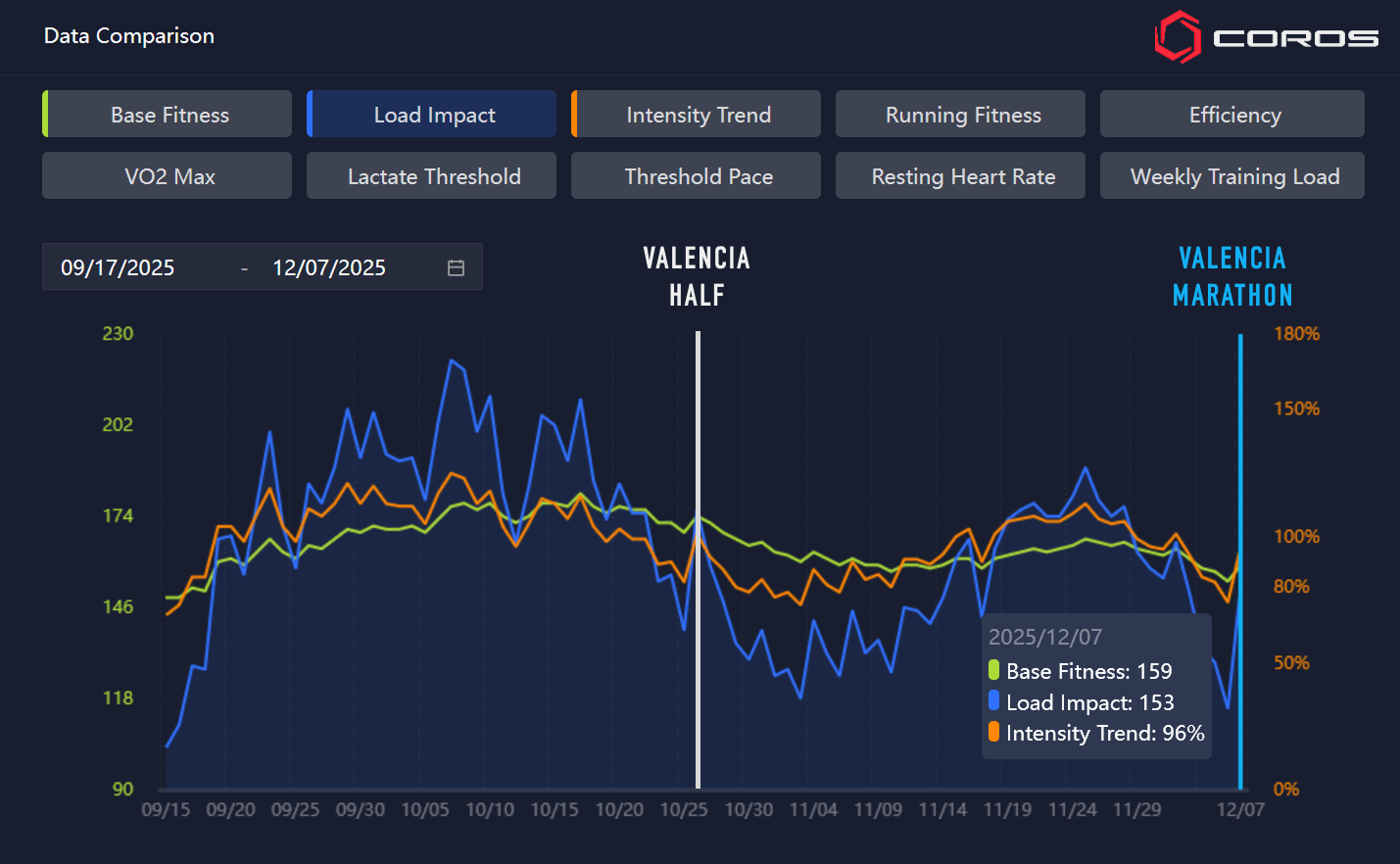
Alex Yee's long-term data throughout the marathon build
Taking a few learnings from his London Marathon build-up, Alex and his team set out to leave no stone unturned in his second attempt at the distance. Starting his dedicated marathon training 12 weeks out from the race, Alex went straight into a hard 6-week block of training, increasing his Base Fitness from 149 to 181. A sign that he was building momentum and gaining fitness.
"Fitness isn’t built overnight; it’s about stacking the small wins. Every day you show up, you add a little more momentum. That’s what this block has been about… trusting the process, staying consistent, and letting the work speak for itself."
Valencia Half Marathon: The Perfect Checkpoint
Valencia Half Marathon is held six weeks before the full Marathon. It's the ideal time to check fitness and preview the course. Alex went into the race with a plan to test his capabilities over the half distance and gauge the effects of the first half of his training plan. He paced almost the entire race in Zone 4, right around his threshold, and finished in 61:29.
The result gave a clear benchmark of where his fitness was, and also provided some learning opportunities that he could apply later on.
"I made a couple of mistakes in the race and missed splits. It was a good run, but I felt like I had more there, so I left feeling super motivated"
With plenty of time to recover and some vital lessons learned, Alex's experience at the half proved to be pivotal when marathon race day came.
Coach's Tip: Racing often provides the strongest insights into your strengths and weaknesses, so always remember to analyze your race data to see where you can improve.
Getting Specific
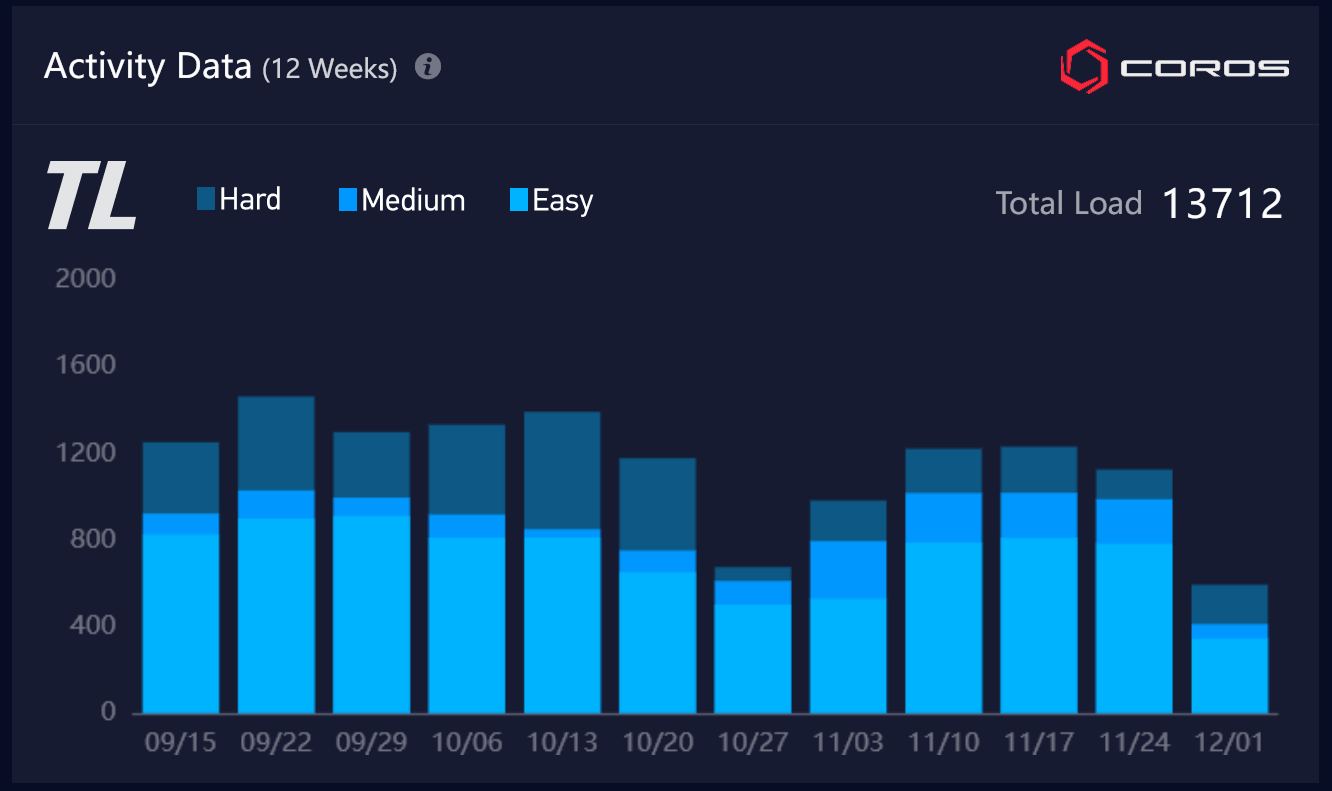
Alex's training load distribution
After the Valencia Half, EvoLab adjusted Alex's Threshold Pace from 3:01/km to 2:52/km. This helped him know his current pace zones right as his marathon-specific work began. During the final six weeks, his Training Load shifted, with a reduction of "Harder" work (zones 5 & 6), and an increase in "Medium" work (zones 3 & 4).
COROS Education: Zones 3 & 4 are right around where your ideal marathon pace should be, with elite runners able to sustain a pace closer to the top end of this.
During these marathon-specific weeks, Alex hit some of his highest mileage ever. His peak week was over 170km, along with an additional 250km of cycling. This is a significant increase compared to his regular average of 70km during his triathlon preparations. During this same week Alex completed his key marathon workout: a 30km run, split into 5 sets of 5km at race pace with 1km at a steady pace. His total time was 1:30:46 (3:01/km) with an average heart rate of 164 bpm. Alex took this as a confidence-builder going into the race.
Alex Yee's Marathon Race Data
One of Alex's points of emphasis for this performance was stride length. When he began to fatigue during his debut, stride length was the first metric to fall off. He focused on cadence & stride length during this block and used them as key markers for progress.
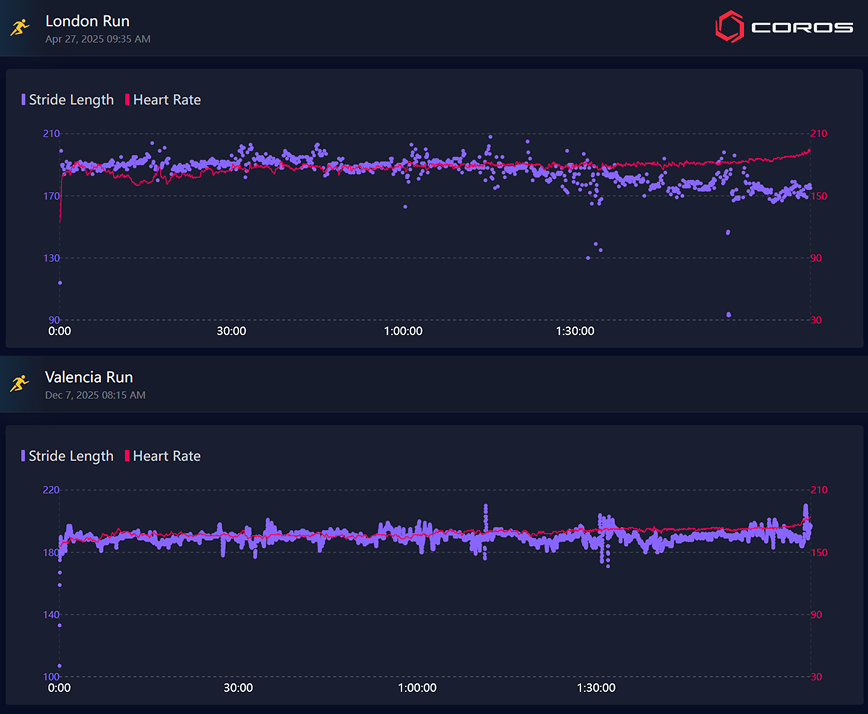
Cadence and stride length are strong indicators of fatigue resistance and are inherently intertwined. Speed can be expressed as stride length X stride frequency (cadence), so if one of these changes, speed will change as well. In London, Alex's stride length (and pace) slipped in the final 10km. His training paid off in Valencia, though, where he actually increased stride length in the final 10km. On top of that, his cadence was slightly higher throughout compared to his debut.
| Distance | London Stride Length | Valencia Stride Length | London Cadence | Valencia Cadence |
|---|---|---|---|---|
| Start-10km | 189cm | 188cm | 173 | 177 |
| 10-20km | 189cm | 189cm | 174 | 176 |
| 20-30km | 188cm | 189cm | 174 | 176 |
| 30-40km | 177cm | 190cm | 175 | 177 |
| 40km-Finish | 173cm | 192cm | 180 | 182 |
The result is also a strong case of executing what he already knew was capable of. Before the race, Alex's COROS Race Predictor showed 2:05:46. His performance, despite the hot conditions, was just 52 seconds from the prediction. With this confidence, Alex can rely on the COROS EvoLab for his future races to plan his pacing strategies.
What's Next?
Alex's race day mantra, a phrase he uses to bring himself to the present, is "What's Next?". This phrase is also what many are asking, as Alex has now spent a year away from the triathlon.
"This year was always about mixing things up, keeping it fun and exciting, but it also offered a chance to experiment and test out some things. It's been a success on all the aspects we wanted."
Alex's new ceiling in running brings an exciting prospect to his triathlon preparations for LA in 2028. This Valencia Marathon journey shows that with the right tools, intentional training, and a willingness to learn you can achieve results that you might not have been expecting.
/filters:quality(90)/fit-in/576x432/coros-web-faq/upload/images/10f25ee51776befd8cd8dc63dfa81294.png)
/filters:quality(90)/fit-in/576x432/coros-web-faq/upload/images/0bb00bf0b066be7f17d3a3d3e1beee22.png)
/filters:quality(90)/fit-in/576x432/coros-web-faq/upload/images/c7a93978e5fbaf1b8085bba7b66b0c67.jpg)
/filters:quality(90)/fit-in/576x432/coros-web-faq/upload/images/ba4307fe6d7862b7f598f37beb9434da.png)
/filters:quality(90)/fit-in/576x432/coros-web-faq/upload/images/98583fe16dec65d912c276f482b72fc4.png)
/filters:quality(90)/fit-in/576x432/coros-web-faq/upload/images/5d72ae8f18d2bee79a21db3b7ae09dd8.png)
/filters:quality(90)/fit-in/576x432/coros-web-faq/upload/images/e21d23067d06142b227654d2731241bc.png)
/filters:quality(90)/fit-in/576x432/coros-web-faq/upload/images/61181416f2e6c01ba0f349592bbaa8d0.jpeg)
/filters:quality(90)/fit-in/576x432/coros-web-faq/upload/images/6a4cc3b80bf5c15283c21e04417d19cb.jpg)
/filters:quality(90)/fit-in/576x432/coros-web-faq/upload/images/bba6f290954f7800c68037c648f573f7.jpg)