


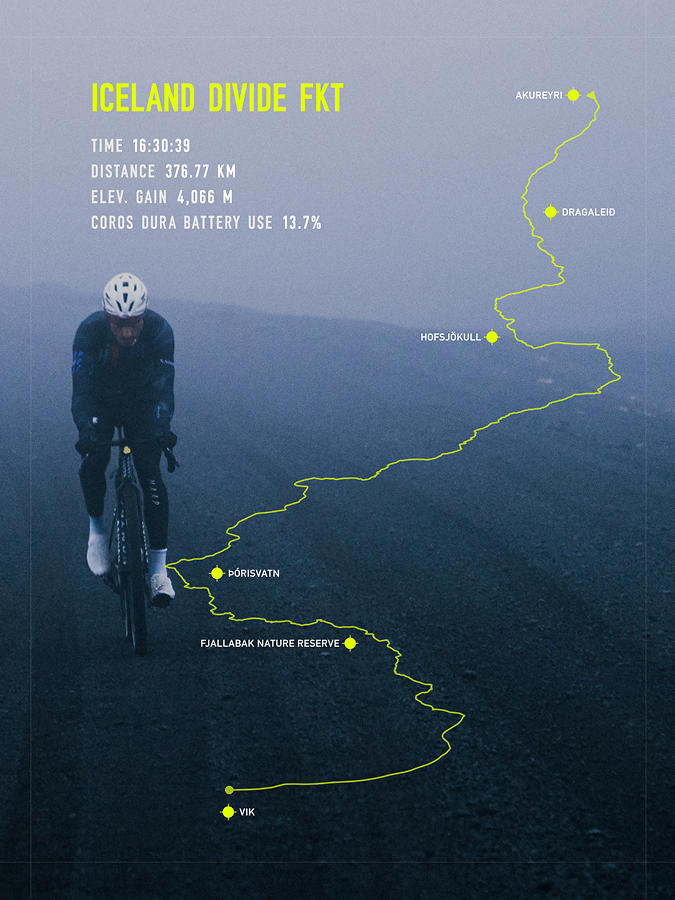
Akureyri, Iceland is known as a port city to most, but cyclists see it as the launching point of the Iceland Divide. The 376-kilometer route crosses the country from North to South, finishing in the seaside village of Vik. In 2021, pro gravel cyclist Payson McElveen completed the trek in 19 hours, 45 minutes, becoming the first to do so in less than a day.
On July 23rd, Freddy Ovett set his sights on that mark. Where McElveen had built his run around daylight, timing the crossing to squeeze the most out of a single calendar day, Freddy chose differently. His plan included a 6 p.m. start, which meant riding straight through the overnight hours, into the strange, unending dusk that passes for night at that latitude in July. 16 hours, 30 minutes, and 39 seconds later, he rolled into Vik, undercutting the record by more than three hours.
Products used:
- Daily Health: COROS PACE 4
- Ride: COROS Head Unit & COROS HR Monitor
A Challenge With No Start List
Freddy has spent most of his career on race courses, lining up against other riders with a clock and a field to beat. The Icelandic Divide offered something different. The idea surfaced in a conversation with COROS at the end of last season, discussing what could come next outside the normal race calendar. Iceland became the answer.
"As much as I love racing, I love even more the idea of challenging myself on my own terms," Ovett said.
There was no one to draft off of and no competitor to read. Just the route, the record, and however long it took to close the gap between them.
The Quiet Part of Preparation
The preparation for a ride like this gets built over months, not days. Freddy points to consistent volume as the biggest factor behind his readiness. Steady, unglamorous training accumulates to a point where you can attack a 376-kilometer crossing, rather than just survive it.
The closer the attempt got, the more Freddy's attention shifted toward something that had nothing to do with power output: sleep. Like most parents of young kids, Freddy knows how elusive real rest can be. Using his COROS PACE 4 to track sleep and recovery through the buildup, he kept a close eye out for any signs of fatigue. Whenever his rest was poor, he'd make a mental note not to push too hard in training.
In the final week before the attempt, his trip to Iceland offered something rare: a quiet corner of the world, far from the usual disruptions, where he could get the perfect rest he needed before the big ride.
"I believe prioritizing rest helped massively, especially considering we decided to go through the night," he said.
It is easy to imagine an FKT attempt as a story about the ride itself. For Freddy, the story started weeks earlier, in the quiet decision to protect his sleep so the version of him riding at 2 a.m. would still have something left to give.
Twelve Rivers and a Vanishing Sun
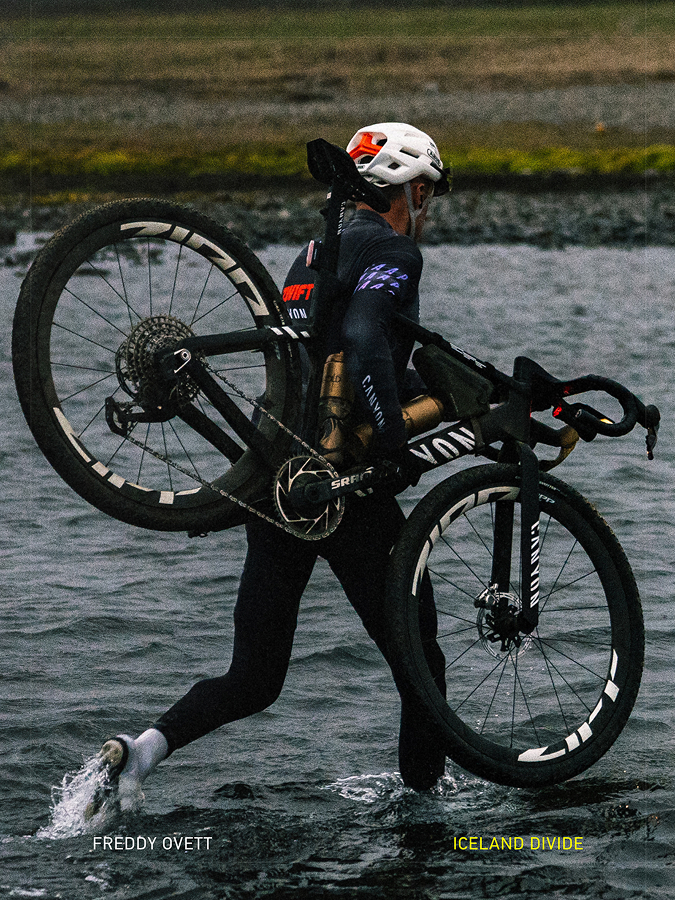
The Icelandic Divide does not ease a rider into the effort. From Akureyri, the route climbs straight into the Highlands, a landscape of loose rock, exposed terrain, and river crossings that show up again and again over the length of the ride. Freddy crossed more than a dozen of them over the course of the attempt, each one a small, deliberate negotiation between speed and caution. A single mistimed line could cost far more time than it saved. The descents that followed were no easier, technical enough that picking a clean path down mattered just as much as the power going into the pedals.
Rough, bouncy terrain is hard enough to manage in full sun. Managing it for hour after hour in that strange Nordic twilight, alone, with only rivers and rock for company, is where the ride becomes more of an act of will.
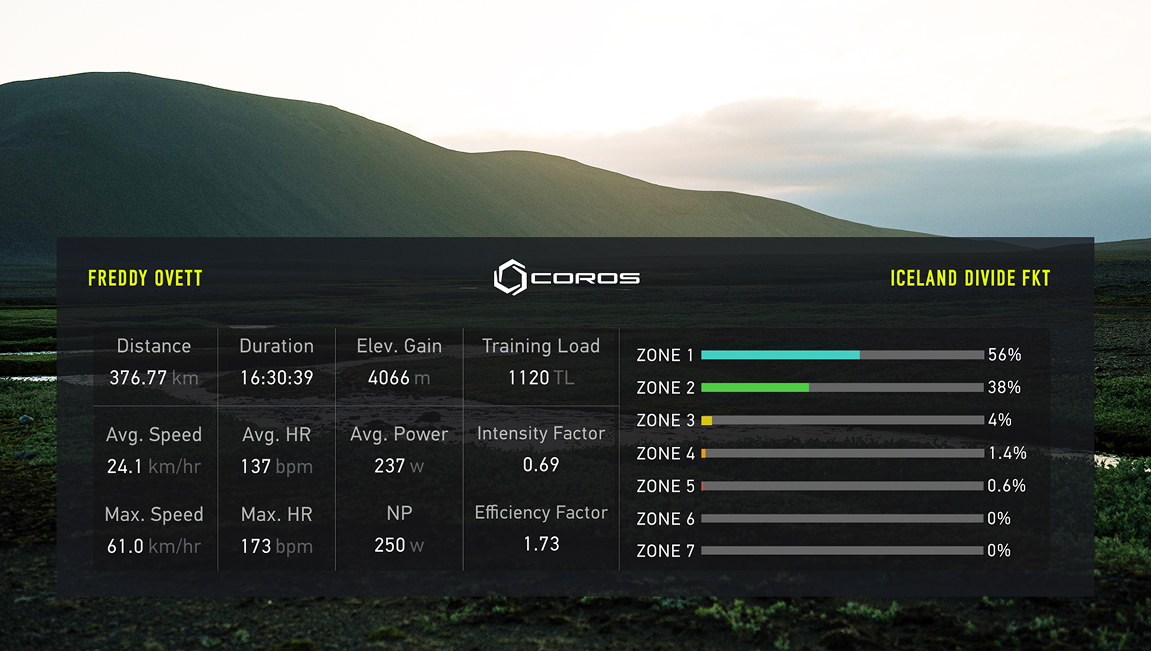
Through it all, a COROS head unit handled navigation and power on the bike, keeping Freddy on route and fueled while tracking his effort in real time. He averaged 237 watts for the entire crossing (94% of that effort stayed in Power Zones 1 & 2), with heart rate holding at an average of just 137 bpm. Both numbers sat comfortably below threshold, allowing him to stay sharp and attack the challenging moments.
Vik-tory
After months of volume, a deliberately rested final week, and nearly 17 hours of rivers, rock, and vanishing light, Freddy triumphantly rolled into Vik. Despite overcast skies and a full night working against solar charging, Freddy's head unit finished the ride with 86.3% battery remaining. "Perhaps more impressive than the ride itself," he said.
Freddy had turned an offseason conversation into the fastest crossing of Iceland ever recorded. The previous mark stood for four years. Freddy took more than three hours off it in one push, and walked away just as impressed by the numbers that quietly held the whole thing together.
/filters:quality(90)/fit-in/576x432/coros-web-faq/upload/images/14f649340ab6c20a52eca1e59d95f539.jpg)
/filters:quality(90)/fit-in/576x432/coros-web-faq/upload/images/8cad1483cef1e9cda5f752e1184d84d9.png)
/filters:quality(90)/fit-in/576x432/coros-web-faq/upload/images/f022ae42f504c192ad110ccf91a257dd.jpg)
/filters:quality(90)/fit-in/576x432/coros-web-faq/upload/images/ac406aff8c98a154d954d1dd38553eca.jpg)
/filters:quality(90)/fit-in/576x432/coros-web-faq/upload/images/35b24c5d17c79770c3e4b15413f47bb5.jpg)
/filters:quality(90)/fit-in/576x432/coros-web-faq/upload/images/a29e1b83ea8be94c5a1a0c6b309273e4.png)
/filters:quality(90)/fit-in/576x432/coros-web-faq/upload/images/7a9d2d79f5661d4341ddf39eb6772741.jpg)
/filters:quality(90)/fit-in/576x432/coros-web-faq/upload/images/57e8b7a39e6dd11a3381fb8a724ee6d0.jpg)
/filters:quality(90)/fit-in/576x432/coros-web-faq/upload/images/727ec9ec3d848a15d9ff6f8ebe33aa0d.jpg)
/filters:quality(90)/fit-in/576x432/coros-web-faq/upload/images/f0c1a94f124a67940008413da0993793.png)