


Cocodona isn't for the faint of heart. The terrain is relentless, the weather unforgiving, and the margin for error razor thin. For three consecutive years, Rachel Entrekin has shown up and left with the win. Her goals in 2026 went beyond winning the women's race. This time, she beat the entire field, men and women, and shattered the overall course record with a time of 56 hours, 9 minutes, and 48 seconds.
How does someone prepare for 250 miles of unforgiving, desert terrain? How do they not just survive it, but rewrite the record books? What follows is a detailed look at exactly how Rachel Entrekin delivered one of trail running's most dominant performances.
Multiple Years of Experience
Before ever setting foot on course in 2026, Rachel came in with multiple wins in the women's race. In 2024 Rachel took first in the women's field with a time of 73:31:25. Returning to defend her throne, 2025 saw Rachel winning again while setting a new female course record of 63:50:55.
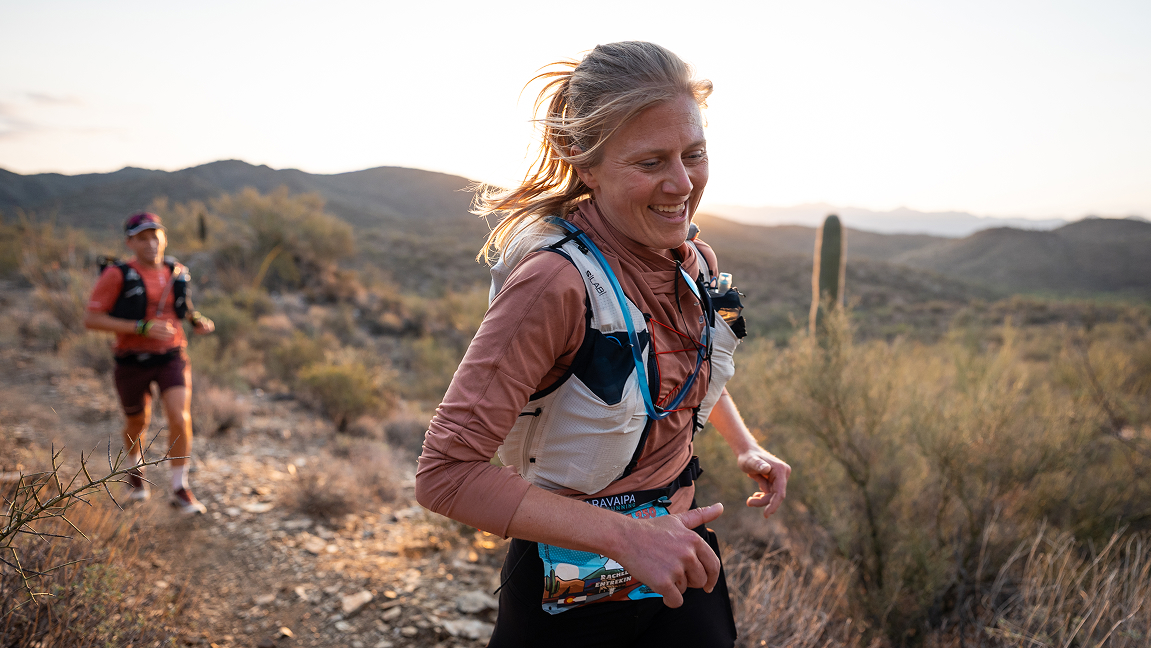
Rachel at Cocodona 2025
It's true that experienced athletes have an edge on the field. They know sections of the course to watch out for. Areas that they can improve upon from years past. How their body will respond under pressure in certain scenarios. The experience led Rachel to her spreadsheets, something she usually doesn't like, but knew would be necessary to approach her race for 2026. The goal was easy to say, but harder to plan.
Rachel's first objective? Break 60 hours. The only problem, every time she ran the numbers, her calculations showed the best she could do was 61 hours and 50 minutes.
Preparing for Sub-60
A new course record doesn't happen by accident. Rachel leaned into her nutritionist, adjusted her strategy on course on the fly, and devoted more time than ever before to her day-to-day training. In the end, all the pieces came together seamlessly. On the training side, there are a few unique insights we can gain by looking into how Rachel prepared for the past 6 months.
Volume and Time
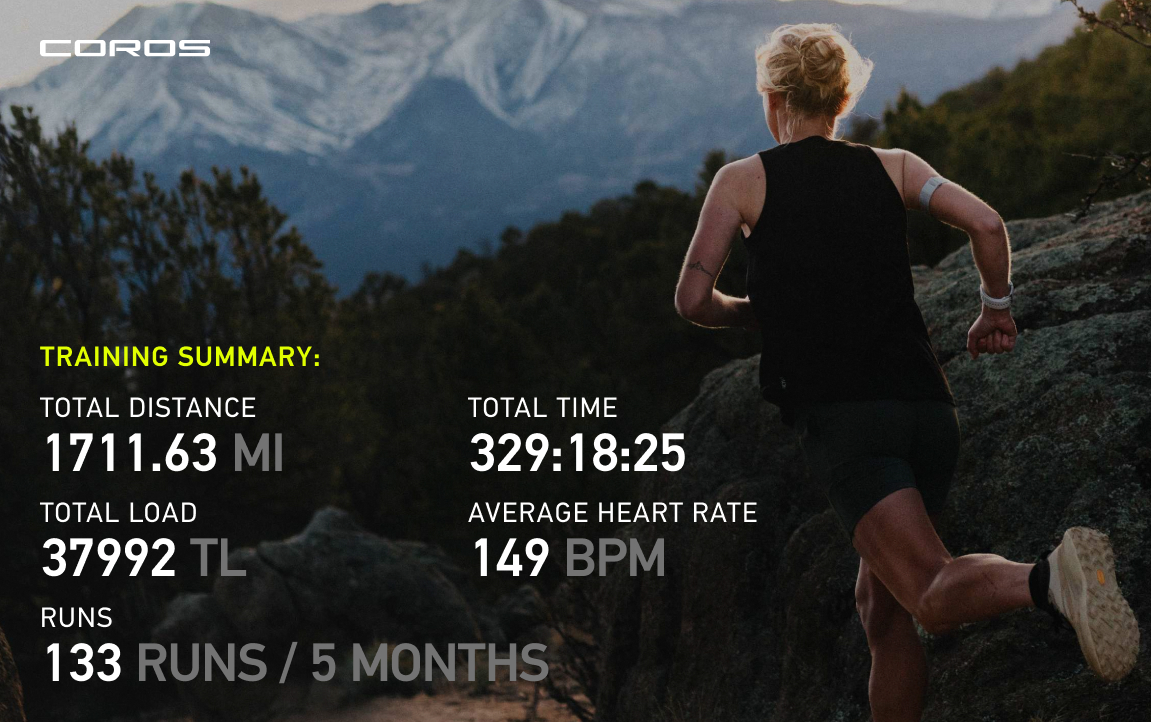
From December 1st, 2025 through May 1st, 2026, Rachel accumulated 1711.63 miles over 329 hours, 18 minutes and 25 seconds of activity time. This averages out to 77.8 miles covered over 14 hours and 58 minutes weekly. A normal week would consist of multiple long runs mixed with recovery days immediately following. Looking at her activity log, it becomes quite clear that many weeks consist of 4-6 sessions, often ecliping 15,000 feet of culmulative gain.
For more specific ultra work, Rachel stacked back-to-back big days, but always allowed her body enough time to recover in the days that followed.
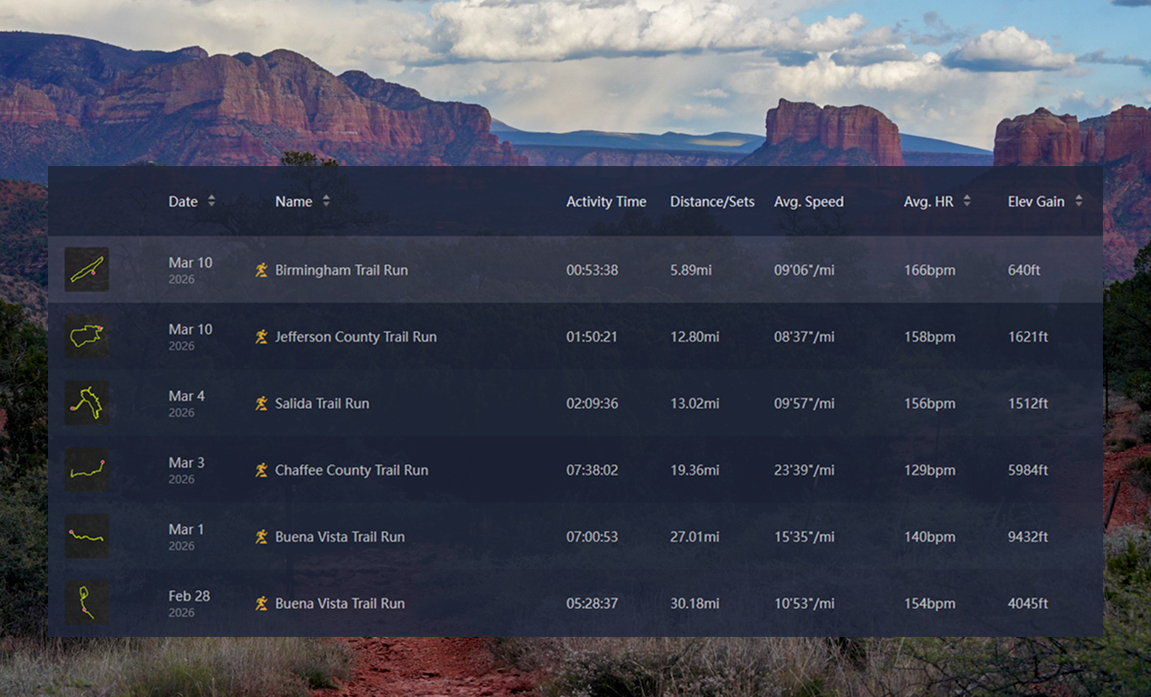
COROS Note: While consistency is a great tactic for many amateur runners, specificity is what leads to results. Rachel was hyper-specific in her build into Cocodona, stressing her body in a similar fashion to what she would experience on race day.
Heart Rate Distribution: Unique Approach
Many ultra-marathoners and even athletes of shorter distances accumulate large chunks of time in zone 1 and 2. This is how they increase volume in a safe and effective way while improving their overall running economy. However, when we look at Rachel's training log, she has a remarkably even distribution between her zones that are specific to endurance running.
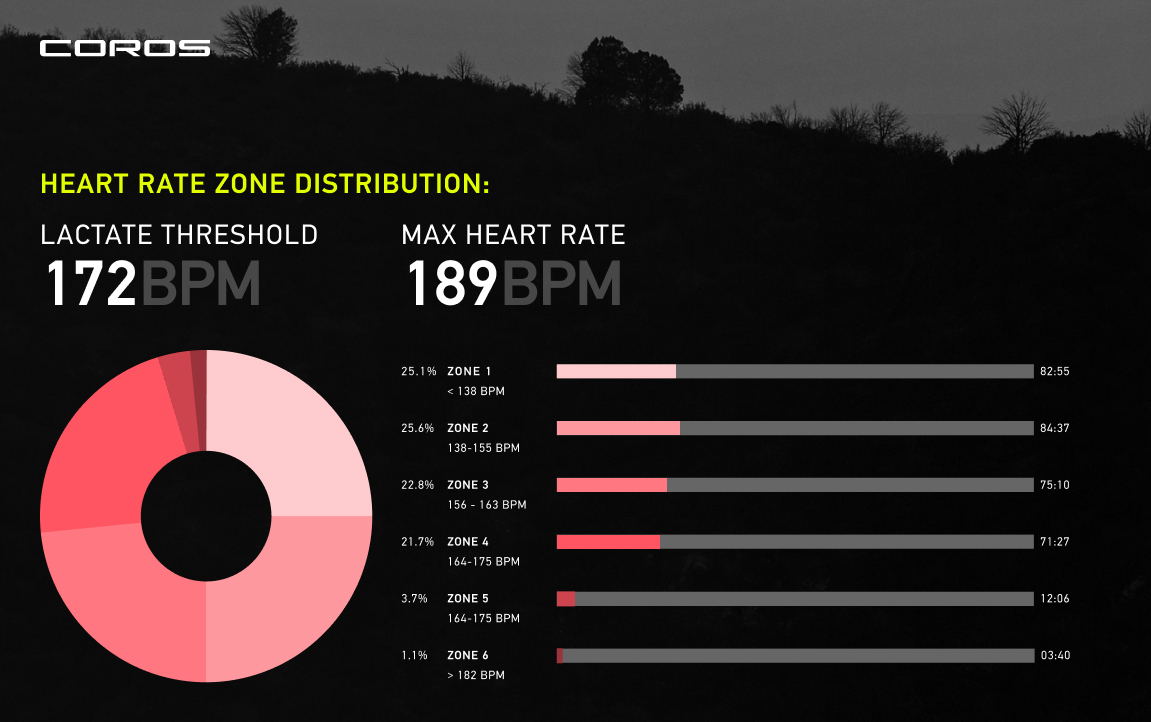
Almost exactly half (50.7%) of her time over the last 6 months was spent in zone 1 and 2. 44.5% of her time was spent in zones 3-4. With the remainder of her time (4.8%) spent in VO2max or above. While this is unique on its own at an elite ultra level, when you combine it with the fact she was training 4-5 days/week with many recovery days, the picture begins to build. Rachel was training to run fast, but allowing her body the necessary time to adapt. She didn't have the most miles in her legs going in, but her body was primed for exactly the effort she wanted to run.
Typical Training Run
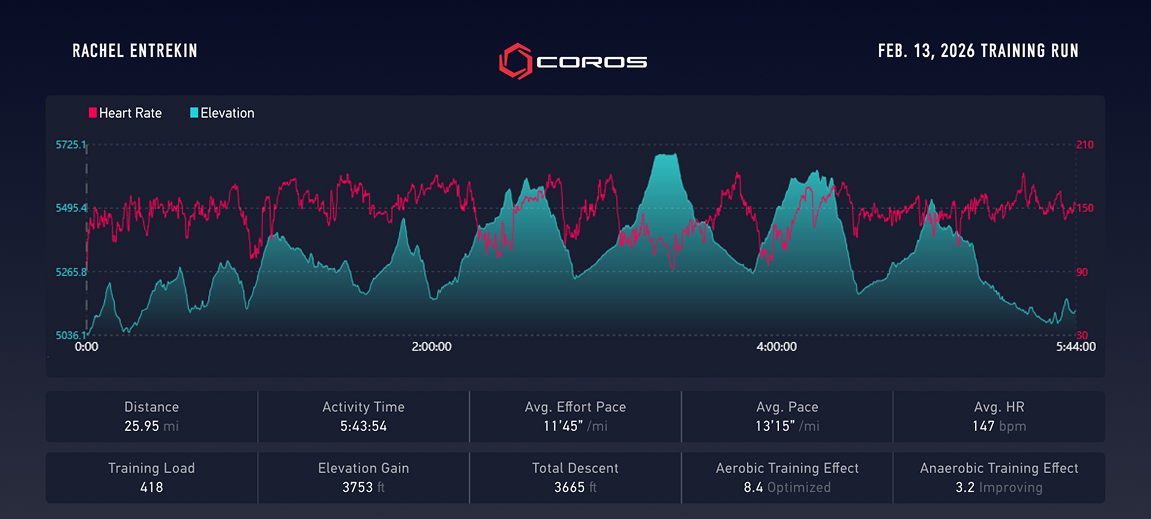
For example, on February 13th, 2026. Rachel set out for one of her typical training sessions. A 5+ hour marathon with 3753 feet of elevation gain. True to her approach, her heart rate averaged 147 beats per minute and 13:15/mile, but perhaps most importantly, Rachel was training for the downhill sections of the course.
What's interesting is that on the downhills, Rachel was pushing serious effort. Often topping out at 170+ bpm. While many athletes view the descents as their time to recover, Rachel was doing the opposite: conserving energy on the ascents, and pushing as gravity takes over.
COROS Note: For training, Rachel wears the COROS APEX 4 and COROS Heart Rate Monitor. On race day, she wore the COROS VERTIX 2S for extended battery life.
The First Half: Start to Jerome
As the clock hit 5AM on May 4th, 2026, Cocodona 250 was officially on. Nerves were high, and rightfully so, with such a daunting task ahead of the 400+ registered participants. With her adrenaline spiking, Rachel hit her highest HR of the entire race within the first 3 minutes, topping out at 184.
Mill Creek Ranch Aid Station (Mile 24.7)
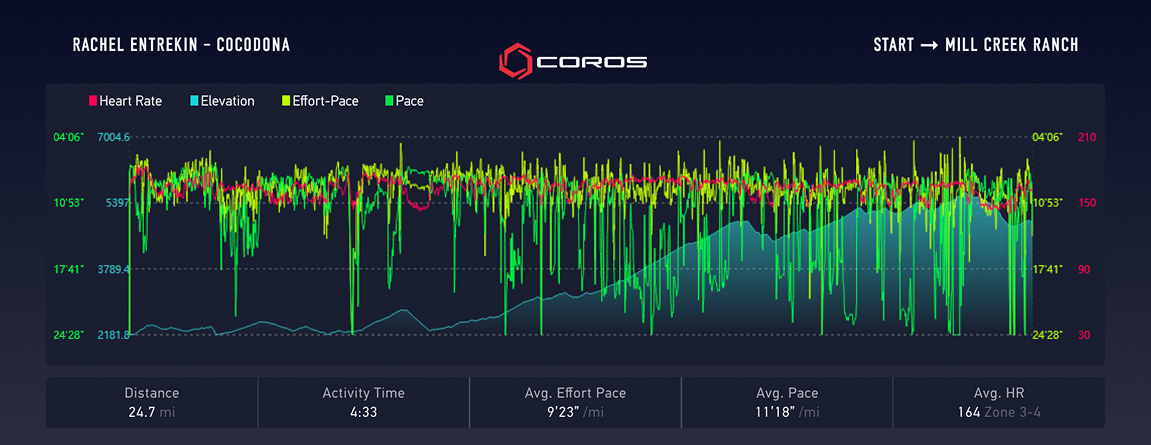
From the start, Rachel's pace and heart rate were high. With the goal of breaking 60 hours, the overall average needed to be 14:00/mile. Wanting to stay near the front of the women's race, Rachel was able to come into one of the first key aid stations with a slight lead.
COROS Note: Effort Pace takes into account the gradient and athlete's HR efficiency at going uphill. While Rachel was running at a true 11:18/mile pace, her body felt as if she had been running at 9:23/mile pace.
Arrastra Creek Aid Station (Mile 25-51)
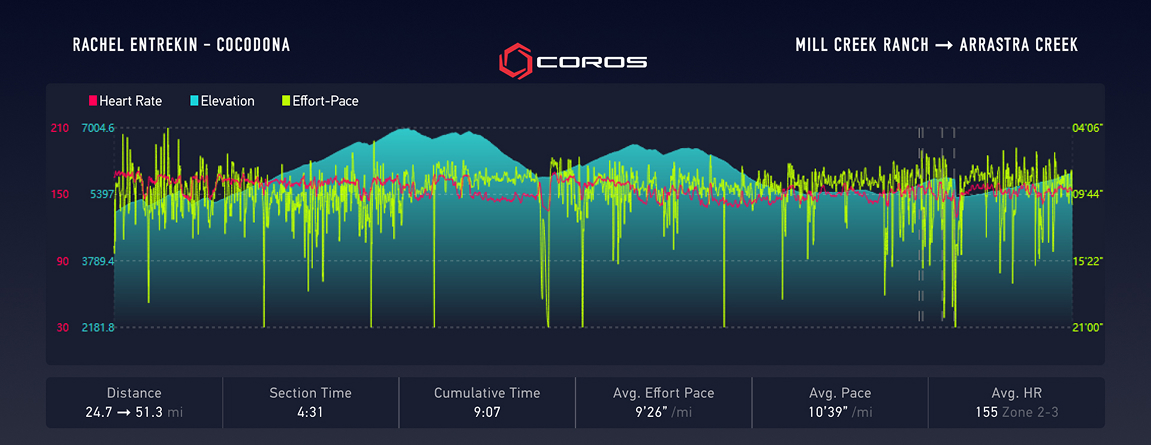
For the next 5 hours, Rachel continued on at nearly the same effort. Racing exactly as she trained, she was able to catch the overall leaders and settle in with Kevin Taddonio and Joe McConaughy. A reprieve from racing solo as lead female, they led the race through Arrastra Creek at 40 minutes below the overall course record (set by Dan Green in 2025 in a time of 58:47:18).
Whiskey Row to Fain Ranch (Mile 75-96)
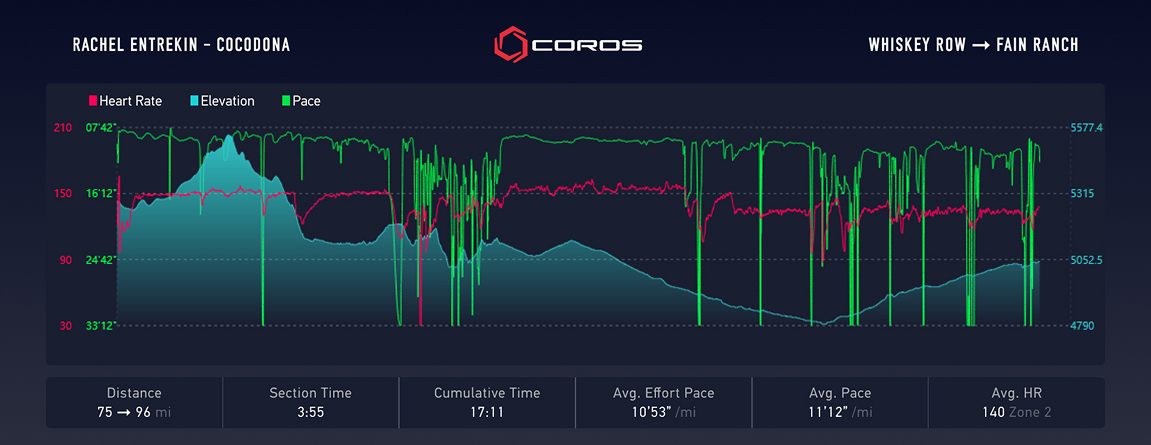
As the sun set on on the opening day of Cocodona 250, Rachel had broken away from the pack and was on a mission to push through the night. Maintaining her aggresive pace, Rachel was not only gaining time on her competition, but also the overall course record.
Fain Ranch to Jerome (Mile 96-124.2)
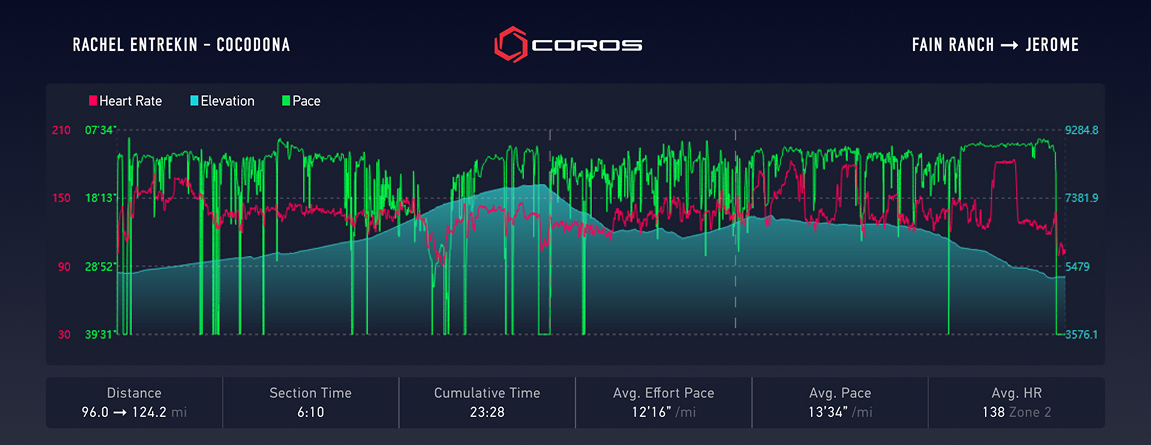
Nearing the halfway point of the race, Rachel came into Jerome with a strong lead over the field as she continued on with her approach. This, however, was a critical point for Rachel in the 2026 edition. In past years, she felt she had given up too much time in the 2nd half of the race. While she was looking great so far, in her mind the real work was only just beginning.
The Second Half: Jerome to Finish
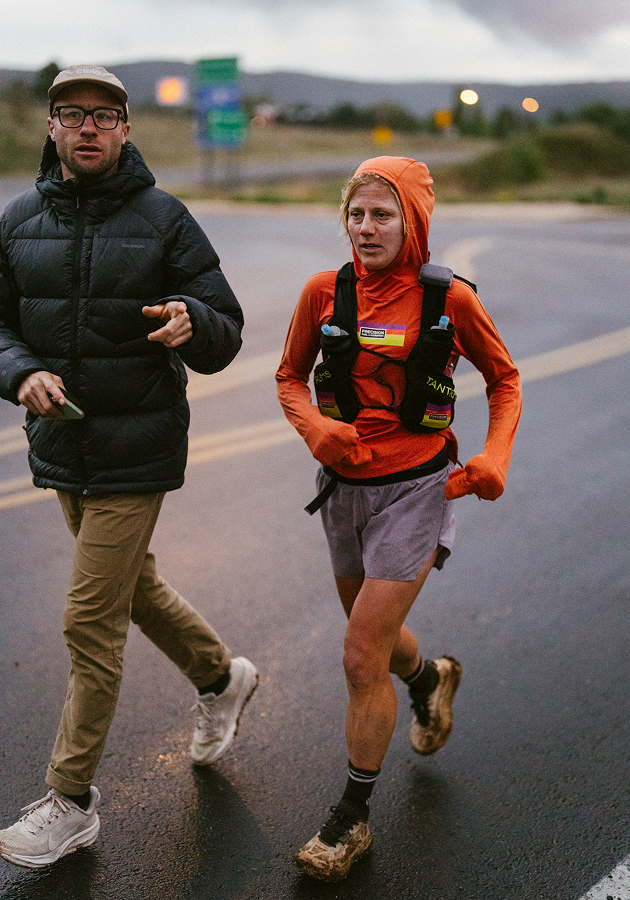
The goal for the second half was simple: beat last year's time of 37 hours and 2 minutes. While this may be easy to write in a spreadsheet or visualize on training days, it's a whole different ballgame to execute it in the middle of the night, 125 miles into a race, as sleep deprivation sets in.
Jerome to Sedona Posse Grounds (Mile 124.2 - 155.8)
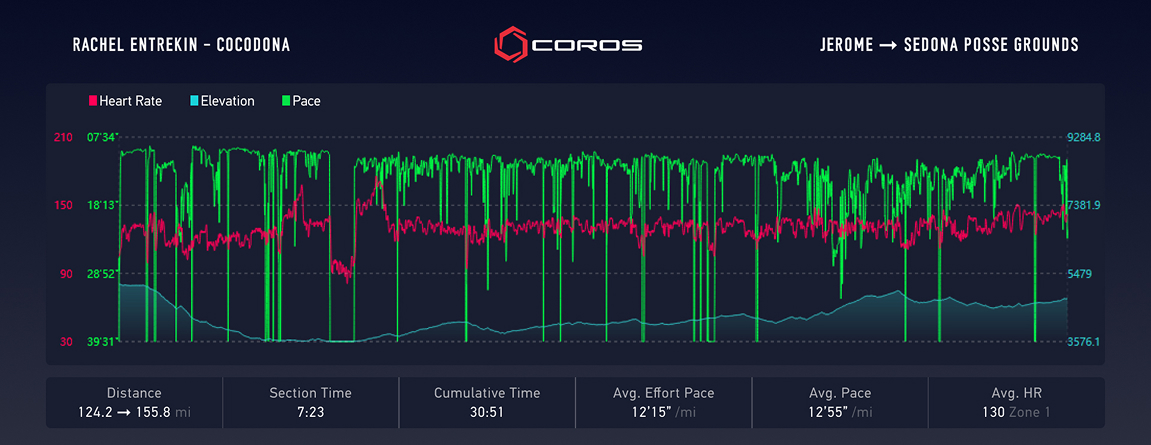
As dawn began to break on day two, the elevation was more forgiving for these 32 miles. With relatively flatter terrain, Rachel was able to settle into a steady pace of 12:57 while holding a cadence of 162. However, Killian Korth, a fellow COROS athlete, was slowly making a move. He had been holding steady in second place since Whiskey Row, but began to close the gap on Rachel. With 100 miles still to go, these two would battle it out with Rachel's lead holding firmly around 2 miles for the majority of the day.
Sedona Posse to Wildcat Hill (Mile 155.8 - 233.7)
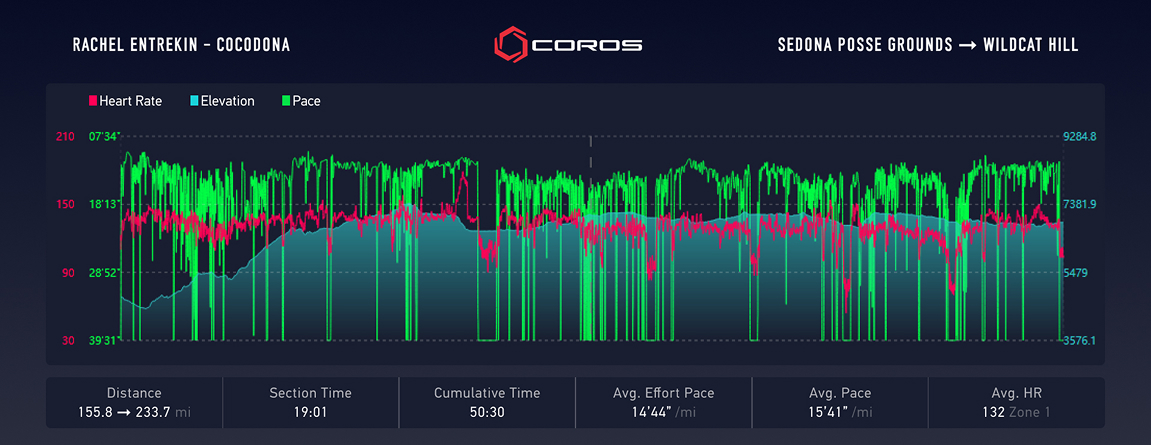
If there was ever a moment when the outcome was in question, this stretch was it. The field was charging from behind. She'd slipped out of an aid station unnoticed, stepping back into pouring rain. Snow was falling on top of Mount Elden. And as night settled over day two, she was alone with her pacer at the front, digging in to hold her pace. Rachel had every excuse to slow down, but didn't take a single one.
The Homestretch: Mount Elden
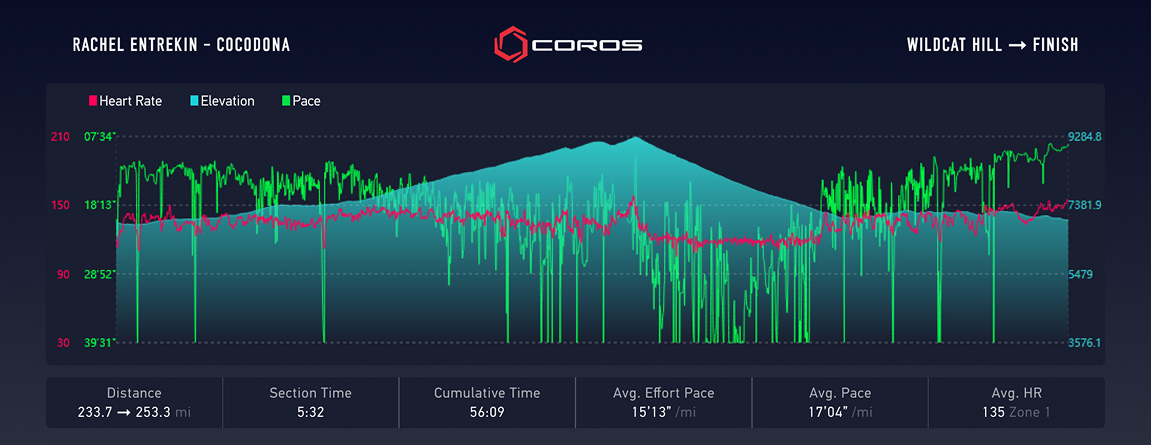
While there are still 6 miles remaining following Mount Elden, this is the late crux of the race. Get over the top first with a decent gap, hold your footing through a steep downhill, and the descent into Flagstaff is yours to enjoy. In past years, Rachel had struggled on this section, but had a goal this year of running as much of it as she could. Remarkably after 50+ hours of running, she ran nearly all of it and extended her lead, the course record now firmly in her sights.
Records are Earned
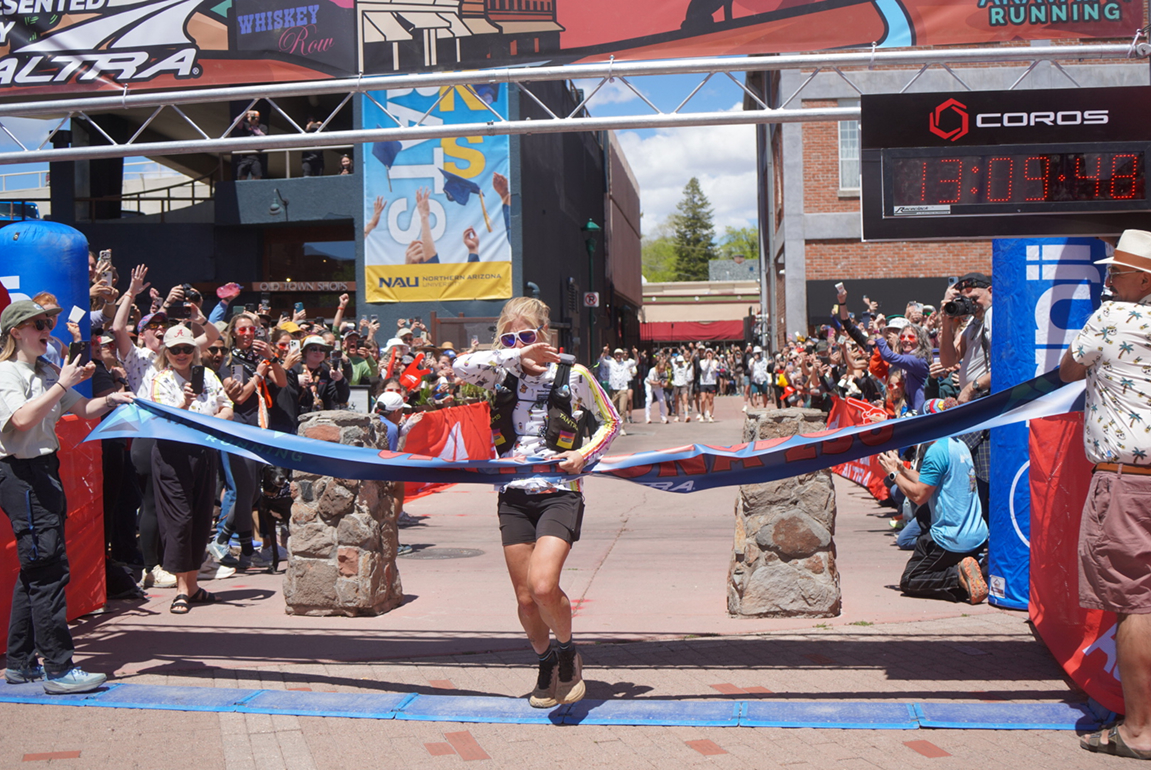
When Rachel crossed the finish line in Flagstaff, the clock said it all. Total Time: 56:09:48.
What Rachel did at Cocodona can't be separated from the training and mindset she established before reaching the starting line. Conventional wisdom says athletes slow as the miles and sleep deprivation stack up. Looking at Rachel's 2026 run, her first half was indeed fast, but she sustained it better than anyone ever had in the second half. A direct reflection of her targeted training that had her body ready for exactly the efforts she was asking for.
When the fatigue finally arrived after Jerome, she leaned on two things: a concrete goal of bettering her own second-half split from the year prior, and a mantra of why not me. What we witnessed was equal parts physiology and mental fortitude. She'd built the engine. Then she refused to let it quit.
While all readers may not have the same ability as Rachel Entrekin, the principle of specificity rings true for everyone. We applaud Rachel on not only achieving her goals at the finish line, but putting plans in motion in the months leading up to the event. These human feats of endurance are remarkable, but they are never by accident. Every result an athlete achieves is earned. Congrats to Rachel Entrekin on her new record, and by doing so, inspiring the next generation of athletes as they ask the question... what is possible?
For more context on Rachel's pre-race mindset, check out our prior article in the weeks leading up.
Editors Note: All analysis conducted fully within the COROS Ecosystem
/filters:quality(90)/fit-in/576x432/coros-web-faq/upload/images/10f25ee51776befd8cd8dc63dfa81294.png)
/filters:quality(90)/fit-in/576x432/coros-web-faq/upload/images/0bb00bf0b066be7f17d3a3d3e1beee22.png)
/filters:quality(90)/fit-in/576x432/coros-web-faq/upload/images/c7a93978e5fbaf1b8085bba7b66b0c67.jpg)
/filters:quality(90)/fit-in/576x432/coros-web-faq/upload/images/ba4307fe6d7862b7f598f37beb9434da.png)
/filters:quality(90)/fit-in/576x432/coros-web-faq/upload/images/98583fe16dec65d912c276f482b72fc4.png)
/filters:quality(90)/fit-in/576x432/coros-web-faq/upload/images/5d72ae8f18d2bee79a21db3b7ae09dd8.png)
/filters:quality(90)/fit-in/576x432/coros-web-faq/upload/images/e21d23067d06142b227654d2731241bc.png)
/filters:quality(90)/fit-in/576x432/coros-web-faq/upload/images/61181416f2e6c01ba0f349592bbaa8d0.jpeg)
/filters:quality(90)/fit-in/576x432/coros-web-faq/upload/images/6a4cc3b80bf5c15283c21e04417d19cb.jpg)
/filters:quality(90)/fit-in/576x432/coros-web-faq/upload/images/bba6f290954f7800c68037c648f573f7.jpg)