


Conner Mantz has had the kind of career that rewrites the record books. This year, though, has been the kind of year that tests whether the person behind those records can handle what comes next.
In the fall of 2025, Conner broke Khalid Khannouchi's 23-year-old American marathon record with a 2:04:43 at the Chicago Marathon. Earlier that year, he broke Ryan Hall's 18-year-old American half marathon record with a 59:17 in Houston. An Olympic Trials win, a top-10 finish in Paris, and a 2:05:08 at Boston filled out a season unlike anything American distance running had seen before.
Then, three to four weeks after Chicago, the pain started
"I had some hip pain, some back pain, and it ended up being a sacral stress fracture," Conner explains. "I took longer than I've ever taken off."
It was only beginning. After returning to running and putting together some promising training, the pain returned. Conner withdrew from the 2026 Boston Marathon the week of the race. Since then, COROS has followed alongside his slow, deliberate build back to record-level fitness.
Data Filling the Gap
With running off the table, cross-training became the job. The swimming alone turned into its own project — he entered the pool at 1:43 per 100 yards and eventually got down to sub-1:30 over long efforts, sometimes spending nearly three hours in the water.
As an unfamiliar discipline, swimming and biking gave him nothing to go on instinct. "There's no pace on a bike or in a pool that means anything to me. But the heart rate and training load — that told me if I was doing enough or too much." Training Load became his guide in that territory, a way to gauge whether a session was providing enough stimulus without digging a hole that would slow his recovery.
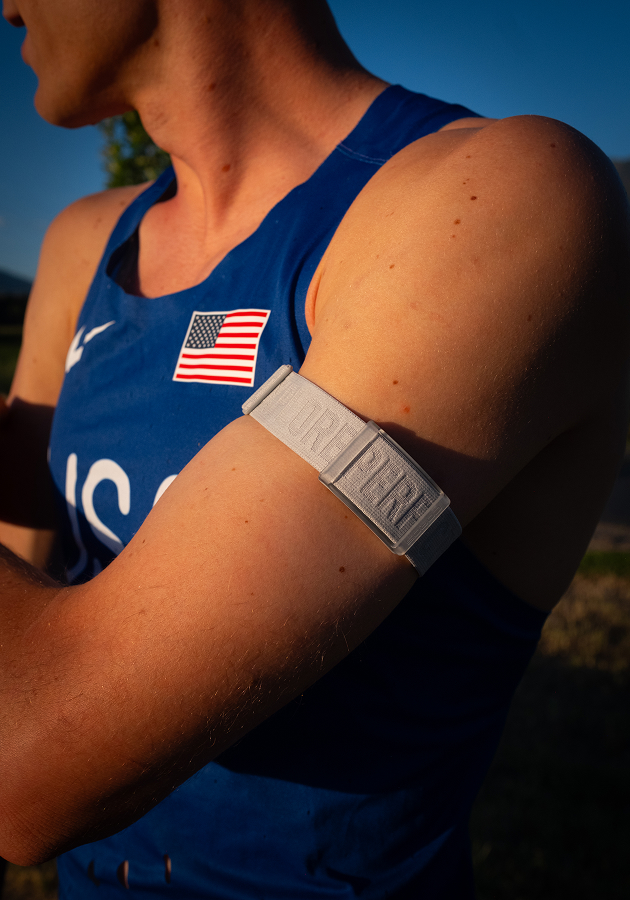
"I don't really use the training load when I'm running. But on the other stuff, it's been nice to measure how hard I'm going on the bike or the arc trainer."
Trusting the Body Again
Once he got back on land, the instinct flipped. Conner calls his competitiveness a double-edged sword, the same trait that built two American records also the one that has landed him injured. In the early weeks back, he put the watch second to feel.
"For the first couple weeks it's mainly just what the body tells me. Some days I'm a little more tired than I would have expected. And if I push through, I just end up injured."
As the miles build back, COROS is on his wrist for every one of them. "A COROS watch is nice because you can look back and review everything. You can run places that are beautiful and then know how far you went and be like, 'Okay, that trail ended up taking more out of me than I thought.' And then you can adapt."
Building Back, Block by Block
Under Coach Ed Eyestone — a two-time Olympic marathoner — Conner returned to a training structure built on repeatable sessions and measured progression. One of their signature workouts is a projected marathon pace (PMP) run that builds in distance across the training block before tapering back down.
"Early on, the pace feels very aggressive and you're usually pushing. But as you bring it down, you feel a lot better."
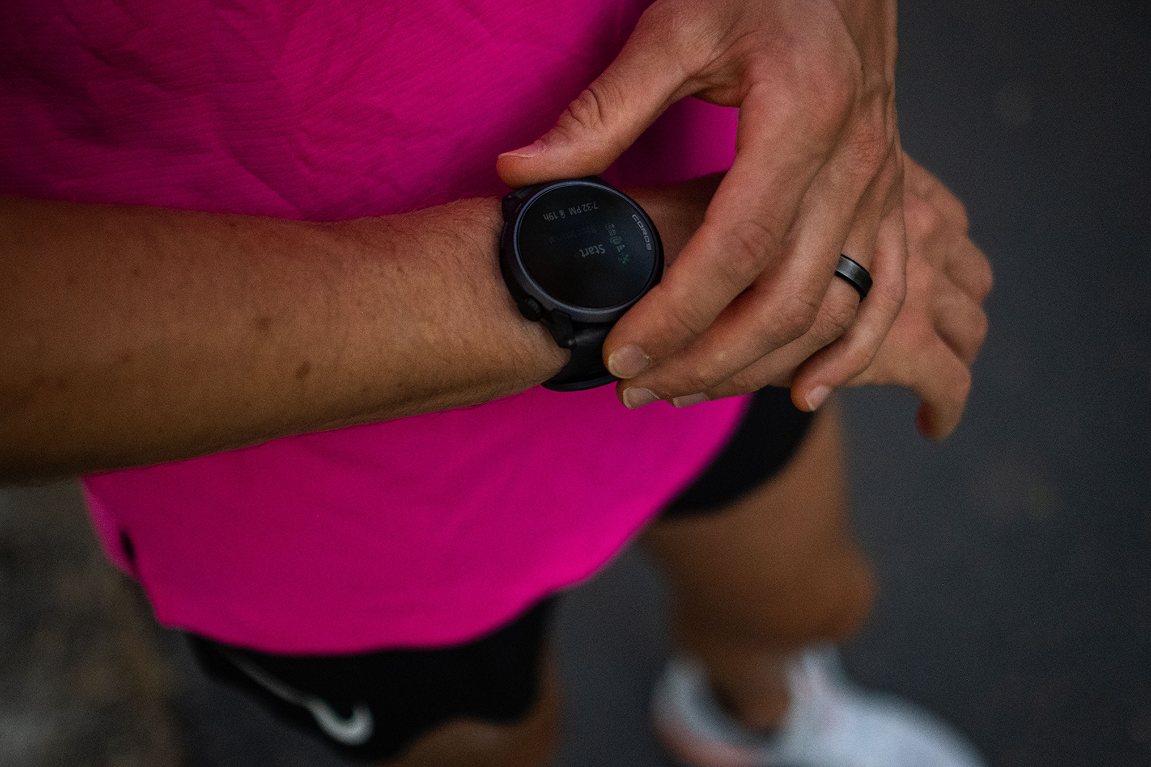
The value of repeating these sessions across a build is that progress becomes visible — not just in the splits, but in the body's response to them.
"It is nice to go back and look at what your splits were, what the weather was like, what your heart rate was. You try to write little notes — this was hard, this was easy, this was a max effort day. And then you can see a trend. It's always nice when you see a trend and everything's matching up."
The Coach Who Keeps You In Check
Eyestone's coaching philosophy is built around restraint as much as intensity. In a group that has grown to roughly twenty athletes, he manages workouts with a paper notebook, a pen, and three stopwatches. He doesn't chase every metric. He reads effort.
"He's a perfect blend between science and art of running and coaching," Conner says.
His workouts come with a built-in guardrail: if Mantz says he could do one more rep, Eyestone asks if he could do two more. If the answer is no, the workout is over. "He always wants us to have a little bit more in the tank."
It's a system designed for athletes who are self-motivated to the point of self-destruction — and Conner knows he's one of them.
Foot Back on the Gas
With the stress fractures healed, the cross-training logged, the mileage rebuilt, and the structure restored, every checkpoint is behind him. Conner Mantz is back to full strength.
On a recent Saturday long run, he put that strength on display. At 4,500 feet of Utah altitude, Conner ran 17 miles at 5:08 pace. The kicker was the heat. The morning sun was already at 69 degrees when he set out, soaring to 88 by the time he finished.
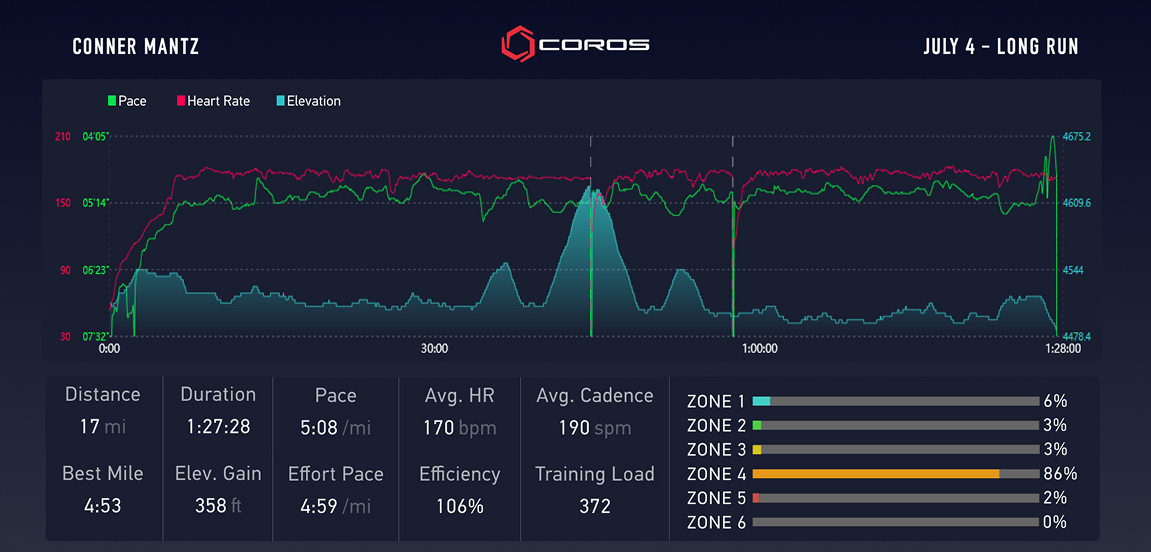
Of the roughly 90-minute run, 87% was spent in his Threshold heart rarte zone, averaging around 171bpm. Today's runs are a world apart from the early-block PMP runs in May that felt like a grind. Somewhere along the way, Conner's stats stopped looking like those of an injured marathoner and started looking like those of a national record holder.
Copenhagen and Beyond
Mantz's next major target is the World Half Marathon Championships in Copenhagen, a race that demands a different gear than the marathon builds he's known for. "The half marathon is so aggressive. You can get two miles in and it can feel very fast. Your legs can be spinning really quickly and you can be like, 'I gotta hold this for another fifty minutes.' It can seem pretty daunting. I imagine this build's going to be a little more aggressive."
It's also a race that excites him for a specific reason: for the first time, he'll be racing against athletes who have gone sub-59 in the half marathon. At Houston, his American record of 59:17 surprised even him.
"That was the first and possibly only race I've been surprised at how well I've done. It would be really cool to go for an individual title as well as compete against guys who are sub-59. How much faster can I run than Houston?"
Mantz is 28 years old, holds two American records, and finished top-10 at the Olympics. And he is, by every measure, still climbing. From here to Copenhagen. From Copenhagen through the next marathon cycle. From there to a home Olympics in Los Angeles. The stress fractures cost him a spring, but couldn't sway his overall trajectory.
The American record holder is back on the roads.
/filters:quality(90)/fit-in/576x432/coros-web-faq/upload/images/10f25ee51776befd8cd8dc63dfa81294.png)
/filters:quality(90)/fit-in/576x432/coros-web-faq/upload/images/0bb00bf0b066be7f17d3a3d3e1beee22.png)
/filters:quality(90)/fit-in/576x432/coros-web-faq/upload/images/c7a93978e5fbaf1b8085bba7b66b0c67.jpg)
/filters:quality(90)/fit-in/576x432/coros-web-faq/upload/images/ba4307fe6d7862b7f598f37beb9434da.png)
/filters:quality(90)/fit-in/576x432/coros-web-faq/upload/images/98583fe16dec65d912c276f482b72fc4.png)
/filters:quality(90)/fit-in/576x432/coros-web-faq/upload/images/e21d23067d06142b227654d2731241bc.png)
/filters:quality(90)/fit-in/576x432/coros-web-faq/upload/images/61181416f2e6c01ba0f349592bbaa8d0.jpeg)
/filters:quality(90)/fit-in/576x432/coros-web-faq/upload/images/6a4cc3b80bf5c15283c21e04417d19cb.jpg)
/filters:quality(90)/fit-in/576x432/coros-web-faq/upload/images/bba6f290954f7800c68037c648f573f7.jpg)
/filters:quality(90)/fit-in/576x432/coros-web-faq/upload/images/5d20e393529dee0c04732a2c877161ee.png)