


After the 2025 Broken Arrow Skyrace 23K, Mădălina Florea had one clear question.
How can I do better next year?
The question has physical, tactical, and even emotional layers. Earlier this season, in a conversation with COROS, Mădălina opened up about pressure, pre-race anxiety, and the process of learning to compete with more calm and presence. Broken Arrow became the performance version of that same evolution: using data not to shut out emotion, but to make clearer decisions under pressure.
The result had been strong. She finished second, but the race showed her that fitness wasn't the only thing that kept her from winning. She needed a better way to manage the course.
Broken Arrow starts in Olympic Valley, CA, climbs into the high alpine terrain of Palisades Tahoe, reaches exposed ridgelines near 9,000 feet, then drops into a fast descent interrupted by one final climb out of Shirley Basin. It is a race where altitude, climbing, and late-race downhill durability all play a factor.
In 2025, Mădălina could hold on, but she could not close the gap.
In 2026, the situation looked eerily similar. Two-time defending champion Joyce Njeru was back again, and the course was unchanged. To force a different outcome, Mădălina's approach had to be the key difference.
Learning the Course, And the Altitude
Mădălina arrived in Tahoe three weeks before race day. She trained at altitude, scouted the course, and repeated key sections until she understood how her body reacted to the terrain.
Early in the camp, she ran the loop in training. Her heart rate climbed higher than planned, and the effort felt harder than expected.
“I told [Coach] Greg, ‘I trained for nothing. What is happening? Why am I struggling so much?’”
This is the kind of moment where doubt could have taken over. Instead, she and Greg looked at the full context: she was on her period, still adapting to altitude, carrying travel fatigue, and processing a demanding training block. The feeling was real, but it was not the full picture.
A few days later, she repeated the same loop.
“When I arrived in Tahoe, I completed the loop in 2 hours 31 minutes,” Mădălina said. “Then we did the workout again a couple of days later. This time I finished in 2 hours 18 minutes.”
The time mattered, but the response mattered more. She felt stronger, moved faster, and controlled the effort better. The fitness was there. Now she needed a race plan that respected the altitude.
Setting a Hard Ceiling
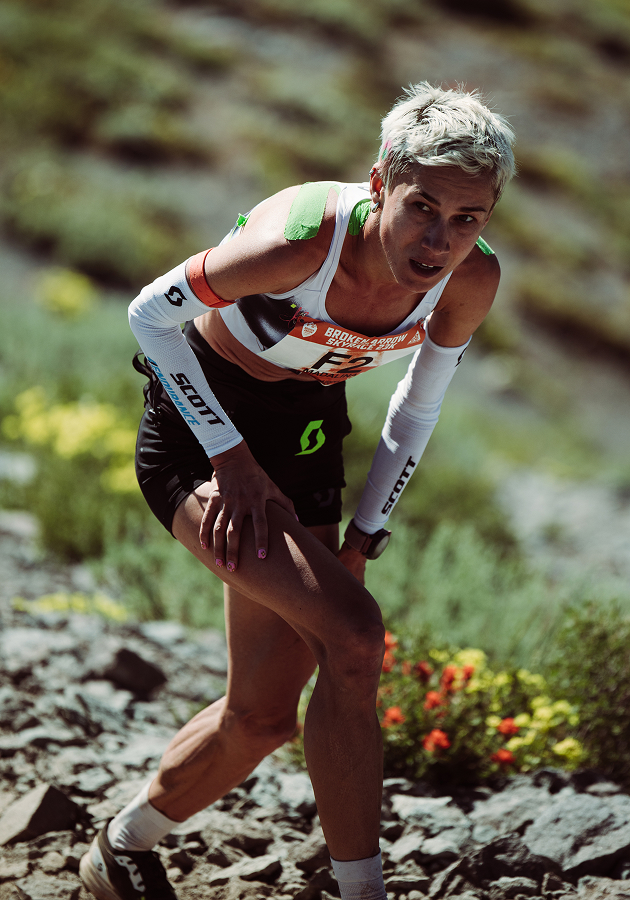
The plan was simple: until the final climb, Mădălina would stay under 175 bpm.
“Greg said that if I went much above 175 bpm at altitude, I wouldn’t be able to sustain the effort,” she said. “So 175 bpm was the maximum limit I was supposed to follow until the last climb.”
Earlier in her career, pace gave her confidence, but on trails like Broken Arrow, pace could lie. Terrain, grade, altitude, and footing all changed the cost of speed. Heart rate gave her a clearer view of what the effort was costing.
“Before, I was scared of working only by heart rate,” she said. “Mentally, I liked seeing the pace because it gave me confidence. But now I see that working by heart rate works.”
When Joyce and the other athletes moved early, Mădălina did not chase.
“When the race started, I didn’t follow the others. I let them go,” she said. “I looked at my heart rate and thought: 'okay, that’s too high'. So I slowed down.”
Every time her heart rate approached 175 bpm, she backed off. Sometimes only for a few seconds. But those small decisions kept the race under control.
“You can actually see it in my heart rate profile,” she said. “Every time I reached around 175 bpm, I slowed down again. That’s exactly what I did throughout the race.”
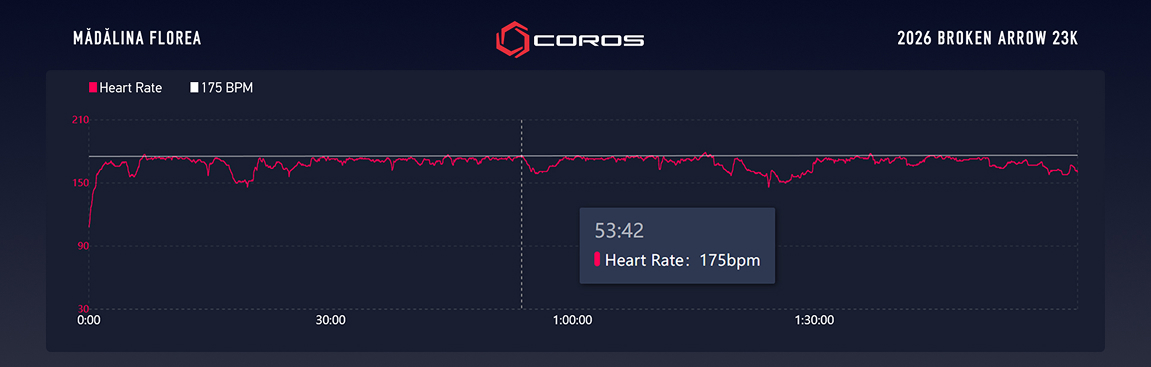
Mădălina knew that 175 bpm was a physiological limit. It gave her a reason to hold back even when the race tempted her to push harder than she should.
Power Hiking as a Performance Tool
Mădălina loves running uphill. On steep climbs at altitude, though, running can spike heart rate without creating enough speed advantage. Hiking became the smarter choice.
“I love climbs and I love to run,” she said. “But I worked on hiking while checking the watch. If I hiked, I could keep a lower heart rate. So even if the others were running, I could walk at the same pace with a lower heart rate and save energy.”
She trained this on the bike and treadmill, building uphill power without relying only on running impact.
Until the final climb, hiking was part of the strategy.
The Moment to Push
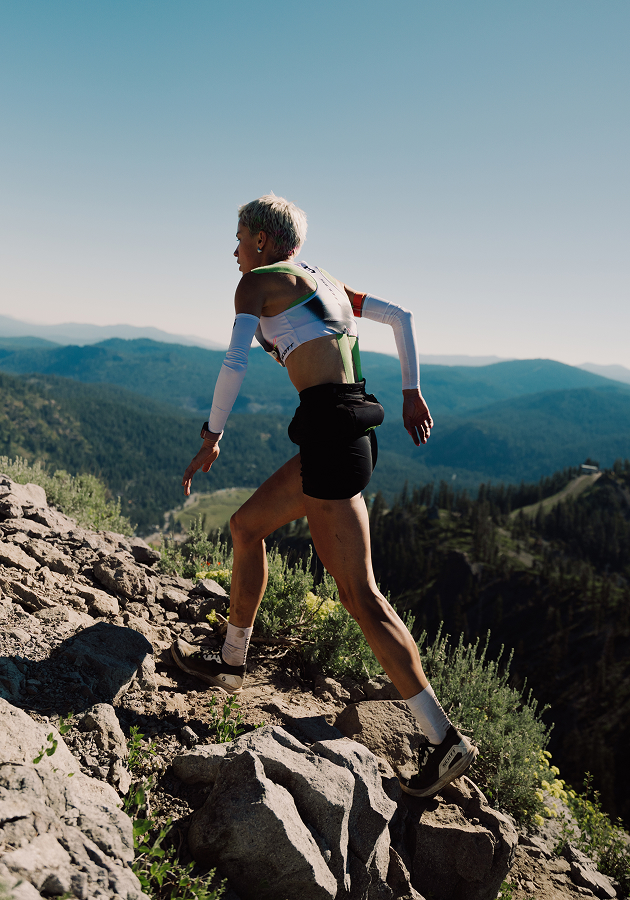
After the descent into Shirley Canyon, the course climbs roughly 550 vertical feet back toward High Camp. This was the moment Mădălina had saved herself for.
Until then, she had controlled the effort. Now, the data and the feeling finally pointed in the same direction. She allowed herself to run uphill. This was the moment she had saved herself for.
The attack was the planned moment to spend what she had saved. She pushed harder than any other point in the race, reaching a max HR of 178.
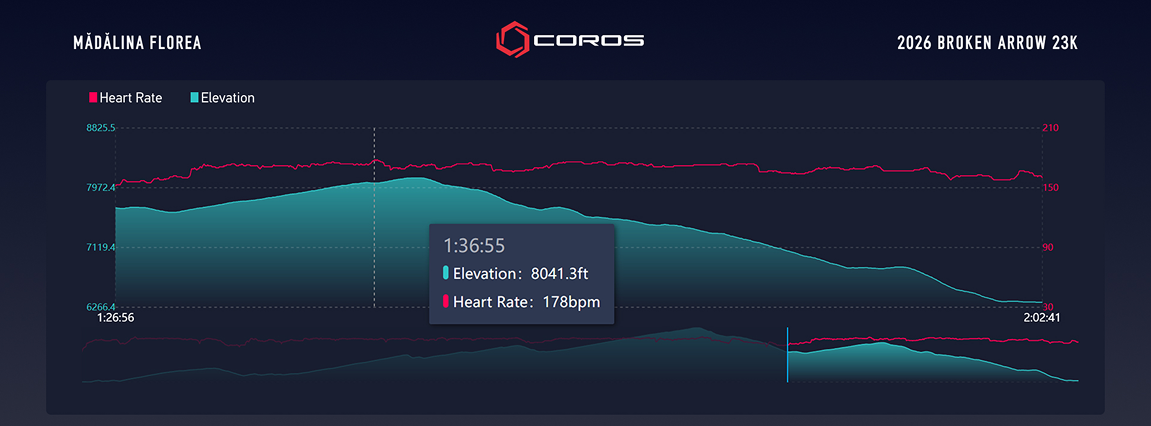
She took the lead at the base of the climb, and held a 16-second lead at the checkpoint. From there, less than 4 miles remained.
The final descent requires technical skill, and being at the end of the course, many are too overcooked to attack it. Mădălina had preserved her legs, and expanded her lead beyond 60 seconds.
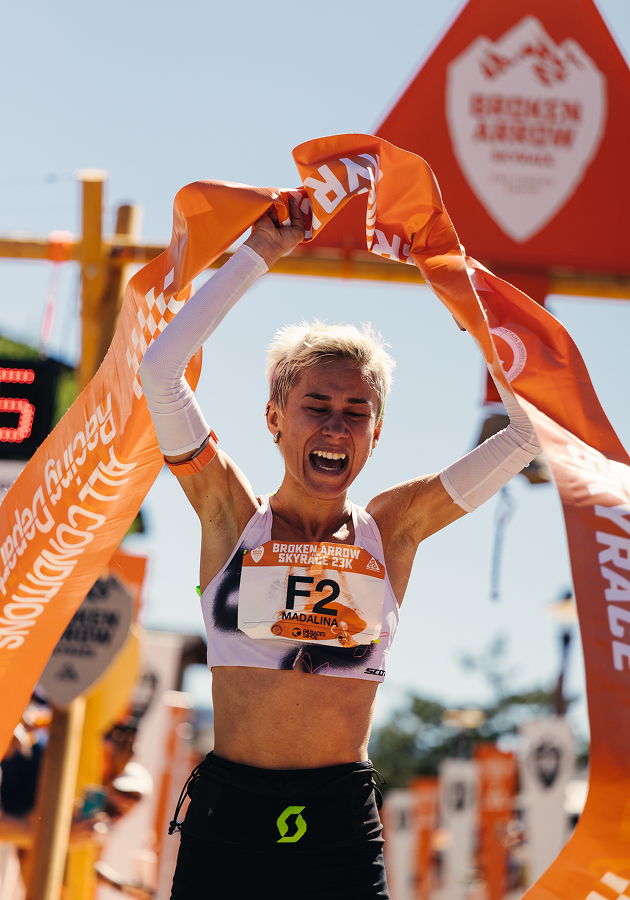
“When I heard I had one minute, I thought: maybe today is my day,” she said. “Then I slowed down and tried to enjoy it, to take my time and feel all the emotions.”
For Mădălina, joy is not separate from execution.
“When you have fun, you are more relaxed and it’s easier to push,” she said.
Fueled by joy down the homestretch, she returned to Broken Arrow and won in 2:02:18.
Twenty-nine minutes faster than her first practice round, and the all-important one place higher than her finish a year ago.
Mădălina won by learning how to listen to the heart — as data, and as the force that kept her racing with joy.
/filters:quality(90)/fit-in/576x432/coros-web-faq/upload/images/10f25ee51776befd8cd8dc63dfa81294.png)
/filters:quality(90)/fit-in/576x432/coros-web-faq/upload/images/0bb00bf0b066be7f17d3a3d3e1beee22.png)
/filters:quality(90)/fit-in/576x432/coros-web-faq/upload/images/c7a93978e5fbaf1b8085bba7b66b0c67.jpg)
/filters:quality(90)/fit-in/576x432/coros-web-faq/upload/images/ba4307fe6d7862b7f598f37beb9434da.png)
/filters:quality(90)/fit-in/576x432/coros-web-faq/upload/images/98583fe16dec65d912c276f482b72fc4.png)
/filters:quality(90)/fit-in/576x432/coros-web-faq/upload/images/5d72ae8f18d2bee79a21db3b7ae09dd8.png)
/filters:quality(90)/fit-in/576x432/coros-web-faq/upload/images/e21d23067d06142b227654d2731241bc.png)
/filters:quality(90)/fit-in/576x432/coros-web-faq/upload/images/61181416f2e6c01ba0f349592bbaa8d0.jpeg)
/filters:quality(90)/fit-in/576x432/coros-web-faq/upload/images/6a4cc3b80bf5c15283c21e04417d19cb.jpg)
/filters:quality(90)/fit-in/576x432/coros-web-faq/upload/images/bba6f290954f7800c68037c648f573f7.jpg)